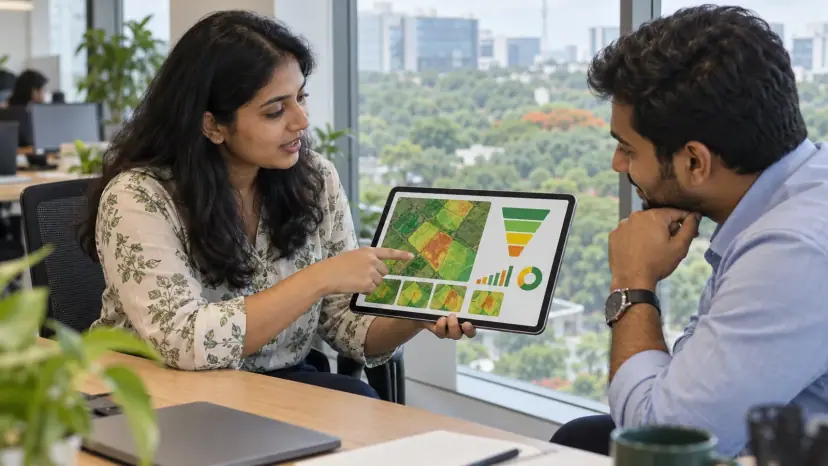
Turning Bengaluru AgriTech brochure downloads into proper demonstration requests
A brochure download tells you very little about field-trial readiness. The person behind it might be a technology buyer checking an integration, a distributor who wants product training, or a grower hoping for crop advice. This Bengaluru guide sorts them into demonstration requests your team can use. The job differs from the Noida agricultural buyer and quote workflow, which covers separate ground.
Around an approved product, Brainguru can plan landing pages, knowledge retrieval and the handoff into your CRM. Delivery runs from Noida, and we do not claim a Bengaluru branch or any local customer result. The examples show how a proposed pilot could be organised. They are not a finished product and promise no agronomic outcome.
Record the field location as well as the office address
The office a buyer works from and the farm, collection centre or installation site they want served are two separate records. A buyer based in Bengaluru may run a site beyond Bengaluru Urban. Get the district and locality before anyone commits to a visit, an installation or field support. The URL stays as the established Bangalore form, while official records should be matched under the name Bengaluru.
Two official pages give administrative and agricultural context: the Bengaluru Urban district portal and its Agriculture Department resource. Parts of the departmental material describe past programmes. Use those pages to find out who is responsible, and never to promise that a subsidy, eligibility or approval is available today.
The Agriculture Department page carries a date of January 2021 and, in one section, refers to Bangalore Rural District. Read it to learn what the department covers, then confirm any scheme or contact with the department itself before it appears on a page. It lists schemes such as the Soil Health Card and crop insurance. Naming one of them is not the same as offering it, and your pages should not suggest that your product qualifies a grower for any of them.
Give each kind of AgriTech enquirer a separate route
- An evaluator comparing products wants the demonstration agenda, the inputs supported, what integration involves and where the limits lie.
- A distributor wants approved product material, a route to the commercial conversation and a plain line between marketing claims and technical evidence.
- A grower asking whether the product suits their land should reach the responsible product or agricultural expert, because a marketing assistant has no business diagnosing a crop from a brief chat.
- A student or researcher may be better served by public documentation than by a sales appointment, so keep those records apart in campaign reporting.
All four routes can draw on one product knowledge pack, with their own form questions and CRM statuses. One unexplained “Book demo” button brings mixed intent and leaves a reviewer doing basic triage.
Write a demonstration brief a buyer can actually assess
Say plainly what the product does and which task the session will cover. Where the system reads sensor records, name the data format it needs, the sampling assumptions behind it and how it behaves when a reading is absent. Where it organises enquiries or stock, show the records it retrieves and the decisions staff still make. Watching an interface is not the same as validating the product in operating conditions.
- Show the input and output the product supports, using an example the product owner has approved.
- Say whether the session runs on synthetic, sample or customer data, and name who can see that data.
- Set out the connections required and who brings the devices, accounts or existing records.
- Name the person who confirms suitability, and list what the session cannot settle.
- Tell the buyer how the agenda will reach them and what has to happen before a pilot can start.
A worked example: someone requests an on-farm trial
The assistant begins by finding out the use case, the operating district, the data or hardware on hand and the role of the person asking. From there it offers an approved agenda, or passes any open suitability question to the technical reviewer. The field-trial request waits until location, access, responsibilities and evaluation conditions have all been agreed. Enthusiasm in a chat does not give permission to collect farm data, and it says nothing about how the product behaves in that environment.
A location beyond the supported area leads to a conversation about coverage. A demand for a guaranteed yield improvement goes to an expert who reviews the claim, and no generated promise goes out. The handoff should carry the reasoning and every field still unresolved.
Ownership decides whether this works in practice. The product owner approves what the demonstration may claim. A named field technician confirms whether the site can take a trial. Sales owns the commercial conversation. If the field technician's role is vacant, trial requests pile up and the assistant keeps saying a reviewer will reply.
Personal data from growers needs care. Collect a name, a phone number, the district and the use case, and keep farm records and photographs for a later step that the grower has agreed to. Under the DPDP Act 2023, say plainly what will be kept and for how long.
Reviewing Kannada and English versions against the same task
Work out language needs together with the business and its audience. Competent speakers should check product terms, units, locality names and demonstration instructions. Then compare what each version captures against one underlying task. A phone number attached to an English brochure download or a Kannada technical question does not turn either into a qualified pilot request.
In a useful knowledge pack, each approved explanation sits beside its product version and its reviewer. Technical advice, warranty terms and commercial commitments stay out of any reply generated without supervision. Note the point at which a question needs a person, and how the buyer gets to them.
Measure how close each enquiry gets to a pilot
Count four things apart: product-interest enquiries, suitable demonstration requests, demonstrations attended and pilots a reviewer has approved. When a request is unsuitable, log why, whether that is the wrong task, an unsupported location, missing data, an unavailable integration or unclear ownership. Look at channels on these outcomes before moving any budget. Extra brochure downloads may help, yet they prove nothing about field performance or revenue.
Run four tests ahead of launch: a question in mixed languages, a sensor field left blank, an operating site in another district and a request for subsidy approval. You are checking classification, evidence retrieval and handoff. The broader sector scope sits under Agriculture solutions, while proof-of-concept development suits feasibility tests where the technology is still in doubt.
In the first weeks, read the reasons logged for unsuitable requests. If many are in a district you do not serve, the page needs a clearer coverage line. If many ask for crop advice, the wording is attracting growers who want an adviser and not a product demonstration. A change in the wording will tell you more than a change in the ad budget.
What to bring when we discuss your AgriTech demo
Please have the approved product specification ready, along with sample enquiry types, the limits of your operating area, a demonstration agenda and the technical reviewer who is accountable. If stock planning is the real question, the demand-forecasting implementation guide fits better than demonstration qualification. Neighbouring operational topics are covered in Bengaluru logistics enquiry planning and Bengaluru e-commerce planning.
You can raise a scoped pilot through our consultation form, or browse the Bengaluru city-guide directory. On-site work, if any, is settled case by case. Images on this page simply illustrate the topic. We last reviewed the official local references on 12 October 2026.