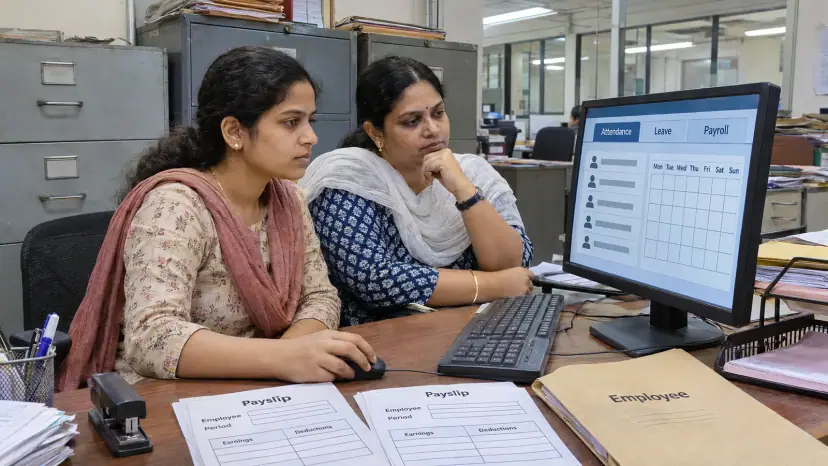
Cloud-based HRMS software is a human resource management system hosted online, so HR teams and employees can manage records, attendance, leave, payroll and performance from any device. Brainguru builds and implements cloud HRMS for Indian businesses, with payroll and statutory compliance handled in the same system as employee data.
Why Indian businesses need cloud-based HRMS software
Indian employers manage workforces spread across offices, sites, states and homes, under labour and tax rules that change. Manual attendance, paper forms and spreadsheets cannot keep up. A cloud HRMS gives one secure place to manage the whole employee lifecycle, from hiring to exit. For a broader introduction, see our article on affordable cloud-based HRMS from hire to retire.
The rules themselves have changed. The Government of India announced that the four Labour Codes, the Code on Wages 2019, the Industrial Relations Code 2020, the Code on Social Security 2020 and the Occupational Safety, Health and Working Conditions Code 2020, were made effective from 21 November 2025, replacing 29 existing labour laws. The same release says that during the transition, the relevant provisions of the old Acts and their rules continue to apply. HR systems need to handle both, and to change quickly as new rules are notified.
People management matters too. Gallup's State of the Global Workplace 2026 found that global employee engagement fell to 20% in 2025, its lowest level since 2020, at an estimated cost of $10 trillion in lost productivity. Good HR software will not fix engagement on its own, but it frees managers and HR teams from paperwork so they have more time for people.
Key features of our cloud HRMS
- Automated HR workflows: Payroll, attendance, onboarding and leave run on rules, with fewer manual steps and errors.
- Central employee database: All employee records in a secure cloud repository, available in real time from any location.
- Employee self-service: Staff can view payslips, apply for leave, update personal details and read policies without waiting for HR.
- Statutory compliance: PF, ESI, professional tax, TDS and gratuity calculations, with the records needed for filings and audits.
- Performance and goals: OKRs, KPIs, reviews and 360-degree feedback in one place.
- Recruitment and onboarding: Job postings, applications, offers and digital document collection.
- Reports and dashboards: Live views of payroll, attrition, headcount and more.
- Mobile access: HR tools for remote, field and hybrid teams on their phones.
Benefits of cloud-based HRMS software
- Time and cost: Automating repetitive HR tasks reduces overheads, errors and administrative load.
- Data security: Encryption, role-based access and secure cloud backups protect employee data.
- Scalability: Add employees, locations and modules without buying servers.
- Employee experience: Self-service gives staff transparency and control over their own information.
- Access anywhere: Run HR from any device, which supports remote and multi-site teams.
- Better decisions: Live dashboards and trend reports show where action is needed.
- Compliance support: Rules for filings and calculations are kept current centrally.
- Faster updates: New features and rule changes arrive without a local upgrade project.
- One source of truth: HR records, communication and processes in one system instead of many.
- Paperless operations: Digital forms and approvals cut paper and filing.
Core modules at a glance
- Employee data management: Store, update and retrieve employee data securely.
- Payroll engine: Salaries, deductions and tax calculations with minimal manual input.
- Attendance and leave: Integration with biometric and GPS tools to track shifts, breaks, overtime and absences.
- Performance and talent development: Goals, appraisals and reviews, with AI-assisted suggestions and reports.
- Recruitment and onboarding: Hiring workflows from application to first day, without paperwork.
- Self-service portal: Employees handle routine HR tasks themselves.
- Compliance and security: Compliance tracking and layered security for sensitive records.
- Analytics and workforce reports: Dashboards and exports for planning.
- Integrations: Links to accounting, ERP, CRM and other business tools.
Cloud HRMS vs on-premise HR software: which fits your business?
An on-premise system runs on servers you buy and maintain, with your own team handling patches, backups and security. A cloud HRMS is delivered over the internet on a subscription, so the provider runs the infrastructure.
| Factor | On-premise HR software | Cloud HRMS |
|---|---|---|
| Upfront investment | Servers and licences bought in advance | Subscription, with no hardware to buy |
| Maintenance and upgrades | Manual and often disruptive | Handled by the provider |
| Access | Usually limited to the office network | Secure access from any location and device |
| Scaling | New users may need new hardware | Adjust the plan as headcount changes |
| Disaster recovery | Depends on your own backups | Redundant backups are part of the design |
For most growing, distributed teams, a cloud HRMS means less maintenance and more flexibility. On-premise can still suit organisations with strict rules on where data is held and the IT staff to run it.
Indian statutory compliance in a cloud HRMS
A capable cloud HRMS builds compliance rules into its payroll and workflow engine, so calculations, deductions and filings are consistent. Because the platform is hosted centrally, rates and slabs can be updated once for every customer when rules change.
- Provident Fund (PF): Employee and employer contributions, with the records needed for EPFO submissions.
- Employees' State Insurance (ESI): Eligibility checks and deductions for covered employees.
- Professional tax: State-wise handling, because slabs and rules differ across states.
- TDS on salaries: Deductions based on the chosen tax regime, investment declarations and exemptions.
- Gratuity and bonus: Calculations based on statutory thresholds and length of service.
The Labour Codes add items to plan for. The same government release lists mandatory appointment letters for all workers, gratuity eligibility for fixed-term employees after one year instead of five, and a single registration, licence and return in place of many. An HRMS should generate letters, track contract types and tenure, and keep filing records in one place. Check every rule with your payroll adviser before a payroll run; software applies rules, but your business remains responsible for them. Our article on cloud HRMS, payroll and compliance in India goes into more detail.
Security and data protection
HR data includes personal, financial and contractual details, so security sits at the centre of any cloud HRMS. IBM's 2025 research for India put the average cost of a data breach at INR 220 million, which shows how expensive weak controls can be.
- Role-based access: Employees, managers and HR administrators each see only what they need.
- Encryption: Sensitive records are encrypted in transit and at rest.
- Reliable hosting: Infrastructure designed for high availability.
- Automated backups: Regular, redundant backups for quick recovery.
- Audit trails: Logs of who changed what, for accountability and reviews.
Employee data is personal data under the Digital Personal Data Protection Act 2023, whose main duties start on 13 May 2027 under the DPDP Rules. Notices, purpose limits, retention periods and deletion on exit are easier to manage when they are built into the HR system.
Cloud HR and payroll software in one platform
Many teams buy separate tools for payroll and core HR, then struggle to keep them in sync. Our cloud HR management system combines both: the platform that stores employee records, attendance and leave also runs payroll, so salaries are always calculated from current data. There is no export and import between an attendance tool and payroll software, and no month-end reconciliation of mismatched records.
Because PF, ESI, TDS and gratuity rules sit in the same system, compliance follows from the payroll run rather than being a separate task. That keeps month-end predictable and leaves the HR team more time for people work.
Who should use cloud HRMS software?
- Startups and small businesses: Professional HR processes without a large IT budget, on a flexible subscription.
- Growing SMEs: One system in place of scattered spreadsheets, growing with the team.
- Large enterprises: Consistent policies, deep reporting and integration for multi-state workforces.
- Remote and hybrid teams: Secure HR services for employees wherever they work.
- Many industries: IT, manufacturing, retail, healthcare and professional services, each with its own shift, payroll and compliance patterns.
How to choose a cloud HRMS
- Does it handle the states you operate in, including professional tax and local rules?
- How quickly are rule changes, such as Labour Code rules, applied?
- Can it connect to your biometric devices, accounting software and ERP?
- Where is data hosted, and who can access it?
- Can you export all your data if you leave?
For the full employee journey, see our guide to cloud-based HRMS across the hire-to-retire lifecycle.