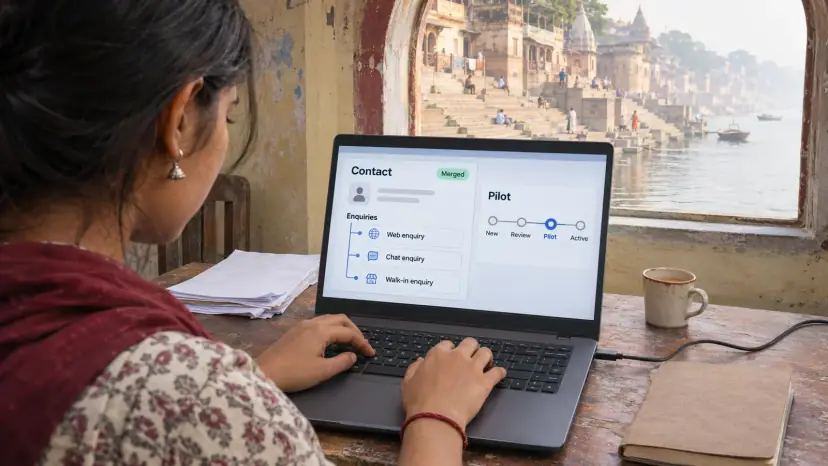
Varanasi, Banaras or Kashi: one startup record and a clear route to a first pilot
A person might look for you under Banaras or Kashi, while your papers say Varanasi. Getting that right is the small start of a larger job: finding out whether a first customer exists. Our guide helps Varanasi startup teams with first-customer validation and pilot-readiness briefs. It explains what to collect, which local source to use, what an assistant may do and at which points a person must approve the next step. The workflows are for planning only, not reported Brainguru client results, and we scope everything around your real business and data.
Three names, one documented address
The district goes by Varanasi, whereas enquiries may also say Banaras or Kashi. Connect these names to a documented address so that you do not end up with duplicate establishments. Destination information should come from current district resources and from the actual operator’s access instructions.
Refer to Varanasi district for the official view. It gives administrative context, not proof of market demand or commercial availability, and it endorses no private business. Save the Varanasi, Banaras and Kashi aliases with the actual address, then see if they agree with your approved business record. A reviewer resolves any disagreement before the page or assistant gives directions, coverage information or a meeting instruction.
Getting the Varanasi brief down on paper
Instead of publishing a city name beside an unrelated national offer, write up the fields below. Note a source and a reviewer for each statement. If you cannot answer a point yet, record that and take it to a person, because a model filling in the blank would leave you with false confidence.
- Target customer and job to be done: Set out the customer you mean to serve and their job, using the actual address however they spell the city.
- Prototype or released-product status: Make the product’s stage plain, along with what it cannot do yet.
- Approved demonstration evidence: Keep a short list of what is cleared for a demo, and mark other material for review.
- Pilot prerequisites and limits: Write the conditions a pilot needs and its boundaries, and date that version.
- Validation question: Choose what you need to learn from this contact, and keep other requests out of the count.
- Founder/product-review owner: Agree which founder or product colleague approves an answer before the next step goes to a prospect.
As a purely illustrative case, suppose a prospect in Varanasi asks to try the product. You run the location check and the check on prototype or released-product status, and a commercial or professional step comes only once both are clear. If one is not, the handoff shows it as unresolved, so your colleague has a concrete question and is not misled by a falsely qualified lead.
Discovery notes, demo briefs and a founder’s judgement
Open with a customer question you can test, and leave out broad promises of rapid growth. AI can bring order to approved discovery notes, prepare a demonstration brief and put enquiry reasons into groups for a founder to read. Be frank about what exists today, what remains a prototype and which next step you can fulfil. Records of incubation interest, investment conversations and customer pilot evidence must stay apart, because participating in an ecosystem cannot demonstrate product demand.
Allow connections only to sources and systems the business has authorised: an approved knowledge pack, the relevant operational system and a CRM or intake route if called for. Attach the version of the note or document that backs each answer. Test who has access and who can edit content before any live customer data appears. A draft, prediction or extracted field is simply something for the reviewer to check, and no commercial commitment follows from it automatically.
Facts a small team must keep straight
Grants, incubator admissions, investors and customer results are facts, and they cannot be invented. Run demonstrations only on authorised or synthetic data. Even a warm referral or first conversation stops short of a signed pilot. Weigh a small experiment against the question it stated before you turn up promotion or take responses as market validation.
Name an owner for each part, even in a team of three. One founder owns the validation question and signs off every answer. Another owns the demo environment and the data used in it. Someone owns the pilot note and its end date. When nobody owns the end date, pilots drift on with no decision, and the team cannot tell whether it has a customer or a favour. Write the three names down before the first prospect hears anything.
Hindi and English, search and watching each stage
Competent speakers should review terminology, locality names and the proposed next step whenever the audience needs Hindi and English. Assess these options with the business, as they are no claim about every customer or that Brainguru provides every translation. The page and business records should give the true address and one contact route, and you should not add offices or profiles to simulate a local presence.
Your audience may be in Varanasi while the service is fulfilled from another place, so hold these details apart. Keep page content and enquiry routing within the approved serviceable area. Observe each stage on its own: discovery enquiry, relevant customer task, demonstration, scoped pilot and evidence reviewed. Rejected, cancelled and unsupported requests are kept in the evaluation, as a click or a conversation brings no revenue.
Plan tests for a prospect outside the intended segment, unavailable demo data, an unsupported feature and a pilot where the buyer has no owner. Put reviewed outcomes beside your own baseline before spend increases. When people reach you through searches that do not match your product, fix that answer or handoff. Our work does not guarantee a ranking, inclusion in AI answers, lead volume or a return on investment.
Before a pilot starts, check what the pilot customer will share. If it includes personal data about their own customers, agree in writing how it is handled and when it is deleted, in line with the DPDP Act 2023. Do not name a pilot customer on your page or in an assistant answer unless they have agreed to it in writing. A pilot that is still running is not a result, and nothing on the page should present it as one.
Where to look next, and what we will ask for
The scope for this sector appears in Startups solutions, while MVP Development for Indian Startups (2026): Scope, Cost and Timeline has implementation detail. It describes a related workflow, and it should not be seen as evidence of a Varanasi client engagement.
Varanasi planning also includes SaaS and Fintech. To see what other cities’ pages support, along with their official references, try Varanasi and other city guides.
We will ask at a free consultation for your target customer and job to be done, your prototype or released-product status, approved source material and the reviewer who can decide the next step. Delivery takes place from our Noida office, and no Varanasi branch is claimed. Scope, integrations and any on-site work are matters for each case.
Our last check of these resources was on 5 October 2026, so recheck current instructions before changing a campaign. Photographs serve only to illustrate the topic and do not verify local offices, customers or facilities.