Mumbai founders: what to check before calling something a pilot
An early meeting can go well and still leave you with no buyer, no owner and no agreed test. Startup teams serving Mumbai can use this guide to validate a first customer and prepare pilot-readiness briefs. You will see the information to record, the local source to look up, the tasks an assistant may take on and the points where a person must approve the next step. Our examples are for planning, and they report no Brainguru client results. We scope services around your actual company, data and permissions.
City, suburb or wider metropolitan address
Mumbai City has a separate district administration. Its portal is not a directory for each place marketed as Mumbai Metropolitan Region. Confirm the real suburb or district before you link a civic contact or property record to a Mumbai campaign.
The portal is Mumbai City district. Consider it administrative context, meaning it does not show market demand or commercial availability and cannot be read as endorsing your startup. Mark your address as Mumbai City, suburban or wider metropolitan, then check it with your approved business record. If those conflict, a reviewer works out the correct version before the page or assistant gives directions, coverage information or a meeting instruction.
A one-page brief before each customer conversation
Your city name beside an unrelated national offer teaches you nothing, so keep a brief with the fields below. For everything you state, know the source and who reviewed it. Unknowns are fine as long as you log them and hand them to a person, and the model never fills them with a guess.
- Target customer and job to be done: Name who you think will buy and the job they need done, plus whether their address is city, suburban or wider metropolitan.
- Prototype or released-product status: Say clearly how finished the product is, so that a prospect knows what they would really be testing.
- Approved demonstration evidence: Decide what you may show, and leave anything unapproved as an item for review.
- Pilot prerequisites and limits: List what must be true for a pilot to start and where it ends, keeping that list current.
- Validation question: Frame what this conversation should prove or disprove, and put unrelated asks to one side.
- Founder/product-review owner: Pick the founder or product person responsible for confirming answers before a next step goes out.
For illustration, take a Mumbai prospect who asks for a trial. Location and product status, meaning prototype or released, both need checking before you suggest any commercial or professional next step. A failed check goes across marked unresolved. That gives the founder a question to answer, and your numbers do not fill up with leads that were never qualified.
Using AI on discovery without fooling yourself
Do not lead with a broad promise of rapid growth. Lead with a customer question that can be tested. AI can sort approved discovery notes, put together a demonstration brief and group the reasons people enquire so a founder can review them. Explain plainly what exists today, what remains a prototype and which next step you are able to fulfil. Treat incubation interest, investment conversations and customer pilot evidence separately, as being part of an ecosystem is no proof of product demand.
Give access only to sources and systems your company has authorised, such as an approved knowledge pack, the operational system concerned and any CRM or intake route you require. Each answer should be traceable to the version of the note or document used. Run tests on access, and on who may revise content, before live customer data is involved. A draft, prediction or extracted field saves the reviewer time, but it binds your company to nothing.
Walk through a scoping call as a planning example. A retail operations manager says she would like to test your reporting tool on last quarter's store sheets. Before the call ends, the founder writes down the task, the sheets she would share, who in her company can approve that, and what would count as a useful result in her words. The assistant turns those notes into a one-page scope and flags anything missing. Nothing is shared until the buyer's owner confirms in writing that the data may be used. At the end of the pilot, the founder and the buyer review the evidence together and choose to continue, change the scope or stop.
Claims a founder should never stretch
Never invent a grant, an incubator admission, an investor or a customer result. Any data in a demonstration has to be authorised or synthetic. A referral or a first conversation is not a signed pilot. Look at a small experiment against its own stated question before you promote more heavily or describe responses as market validation.
A common mistake is to call every early conversation a customer. It happens because a growing list feels like progress. Keep a plain status for each contact: introduced, discovery held, scoped, running, reviewed. Only the last two describe anything a buyer has actually tested, and your page and any pitch should use those words and no others.
Marathi, Hindi and English, listings and proof at each stage
Have competent speakers go through terminology, locality names and the proposed next step in any Marathi, Hindi and English content your audience needs. Assess those options yourself, as they do not suggest every customer uses them or that Brainguru supplies every translation. Show the real address and the same contact route on the page and across business records. Faking local presence with more offices or profiles is off the table.
People may hear of you in Mumbai while the work is fulfilled elsewhere, so note audience location and fulfilment location individually. Only the approved serviceable area should shape your page content and routing. Keep separate counts for discovery enquiry, relevant customer task, demonstration, scoped pilot and evidence reviewed. Keep rejected, cancelled and unsupported requests in the evaluation too, because a click or a talk with a prospect is not revenue.
Use four test cases: a prospect outside the intended segment, demo data you cannot get, a feature you do not support and a pilot with no owner at the buyer. Check how reviewed outcomes compare with your own baseline before spending more. Search queries with the wrong intent are a cue to improve the answer or handoff concerned. Do not expect any guarantee from us about rankings, AI answers, lead volume or return on investment.
More to read, and what to bring to us
For industry scope, read Startups solutions. For implementation detail, read MVP Development for Indian Startups (2026): Scope, Cost and Timeline, which is about a related workflow and offers no evidence of a Mumbai client engagement.
Mumbai planning extends to SaaS and Fintech too. The collection of Mumbai and other city guides shows how official references and supported information differ by location.
Bring these to a free consultation: your target customer and job to be done, your prototype or released-product status, approved source material and the reviewer who can decide the next step. We would deliver from our Noida office, as we claim no Mumbai branch. Decisions on scope, integrations and on-site work depend on your case.
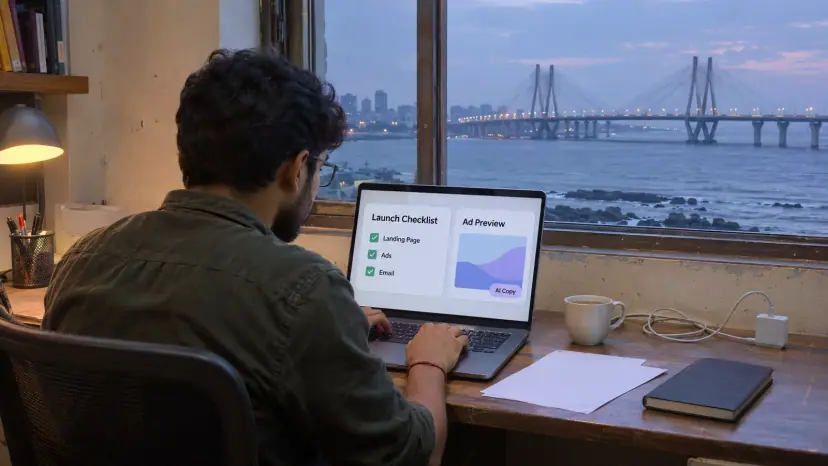
The sources here were last checked on 5 October 2026, so confirm current instructions before you adjust a campaign. Any photographs illustrate the theme and are no verification of a local office, customer or facility.