Indore founders: turn your pitch into a test with real customers
You may have a pitch that convinces people in a room, and still not know which buyer will take the next step. This guide is about validating your first customer in Indore. It is not about fundraising promises or a city-wide advertising plan. What you want at the end is a documented buyer problem and an experiment that tells you whether to keep, change or stop a message. Brainguru can help with landing pages, enquiry routing and analytics, working remotely from Noida.
Using the Madhya Pradesh ecosystem without implying endorsement
Startup MP is the state's official startup programme, and Startup India is the national one. Use them to find relevant support organisations and to check current contact details. Then confirm the organisation's actual location, eligibility and application route with it directly. Being in a directory is not an invitation or a funding approval, and it does not show that a founder has been accepted.
Treat an ecosystem application and customer discovery as two separate jobs. Mentors, event attendees and programme reviewers can give useful feedback, but they are not automatically your buyers. Do not show institution logos or claim support unless you have authorisation. This page does not claim any Startup MP affiliation or the ability to secure a grant.
Keep a separate list for people who are programme contacts and people who are buyers. A mentor who likes the idea can still tell you, truthfully, that nobody in their network would pay for it.
Write your own experiment brief
Pick one intended buyer and one problem. Write down what they use today, the next step you want from them and what information would make you change direction. For a business-to-business prototype, that step could be a discovery call with the person who owns the workflow. For a consumer service, it could be a task completed in the prototype. Keep these events apart and do not lump them under a generic conversion label.
Show real product screenshots when the feature exists, and clearly label mockups and proposed functions. AI can draft other ways of explaining your idea from your approved brief, but it must not invent integrations, partnerships or active customers. Keep the page short, and say what works now, what is still experimental and who answers support questions.
An example helps here. Suppose a founder is building a tool that sends appointment reminders for small clinics. She picks one buyer, the practice manager, and one problem, patients who miss slots and leave the day's schedule with gaps. She writes down how the manager handles reminders today, which might be a phone call from the front desk. The next step she wants is a thirty-minute call where the manager walks through one real week of bookings. She also writes the result that would make her change direction: if managers say reminders are not their problem and point to something else, she stops pitching reminders and asks what that other problem is.
Link local interviews to a small channel test
When you recruit interview participants in Indore, explain your intended role and why the conversation matters. Agreeing to a research call does not mean agreeing to unrelated promotional contact. Record voluntary feedback, permission to quote and commercial follow-up preferences separately. A private interview must not become a public testimonial without approval.
Here is an illustrative test. Two messages describe the same supported feature to the same suitable group of buyers. Record exposure, qualified responses and completed discovery calls, plus the reason anyone declined. Look at the actual sample size before you call one message the winner. If each version has only a few responses, report the uncertainty and avoid a precise growth claim.
In the first weeks, watch three things and ignore the rest. First, whether people who agree to a call actually turn up, since a booked call that nobody joins says more than a polite reply. Second, whether the people you reach hold the role you wrote in the brief, and not an assistant or an adviser. Third, which objection comes up most. If the same objection appears in call after call, it is evidence about the product or the price, and a new headline will not remove it. A message that attracts the wrong role should be rewritten before anything else changes.
Checks before a founder-led message goes out
A small team can still make mistakes that a big one would catch. Run through these before the first message or page goes live.
- Permission to contact: Know how you got each name and what the person agreed to. A list bought or copied from an event is not consent for promotional messages, and India's DPDP Act 2023 applies to the personal data you hold. Keep a note of the source for every contact.
- Calls and messages: Commercial calls and text messages are regulated by TRAI, so check its current rules, or use email or a request form, before running outreach by phone.
- What exists today: Every claim on the page should match what a visitor can use now. Put planned features in a clearly labelled section.
- Who answers: Name the person who reads replies, and how soon they will answer. A reply that waits a week costs more than a weak headline.
Who does what in a two-person team
Many Indore startups at this stage are two or three people, so write down who owns each job. The founder who sells should own the buyer hypothesis and run the calls. Someone else, or the same person on a fixed day, should own the log: who was contacted, what they said, which message they saw and what happened next. When nobody owns the log, each call becomes a memory, and by the third week the team cannot say which objection came up first. Agree the log fields before the first call and review it together once a week.
Let the results decide your next product step
Compare what people said in interviews with what they actually did. A kind comment is weaker evidence than a buyer completing the agreed next step, and neither proves product-market fit on its own. Note whether objections are about the problem, usability, procurement or a feature you do not support. Your next change may belong in the product and not in the ad account.
Bring your buyer hypothesis, current prototype and experiment log to a free consultation. You can also read about startup AI growth, MVP planning and campaign link tracking. We agree scope and commercial terms after a review, and we promise no Indore office, funding result or fixed acquisition outcome.
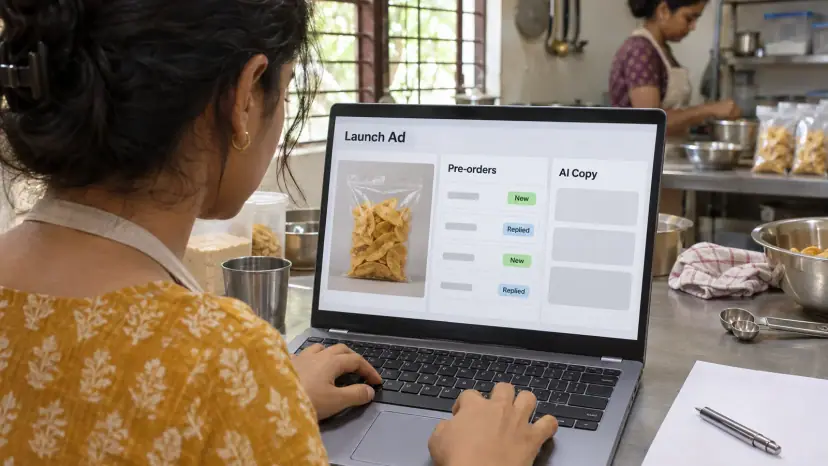
We checked these local resources on 5 October 2026. Recheck the instructions at each source before using them in a campaign, and review local links every quarter. Photography is illustrative and is not evidence of a local office or client.
Set the stopping rules before you start, in words. Say what you would need to see to keep going with this buyer, what would make you switch to another buyer, and what would make you drop the idea. Write them in the log with the date. Founders who skip this step tend to read every result as a reason to continue, because they have already spent the time. A rule written earlier lets a lukewarm outcome count as the answer it is.