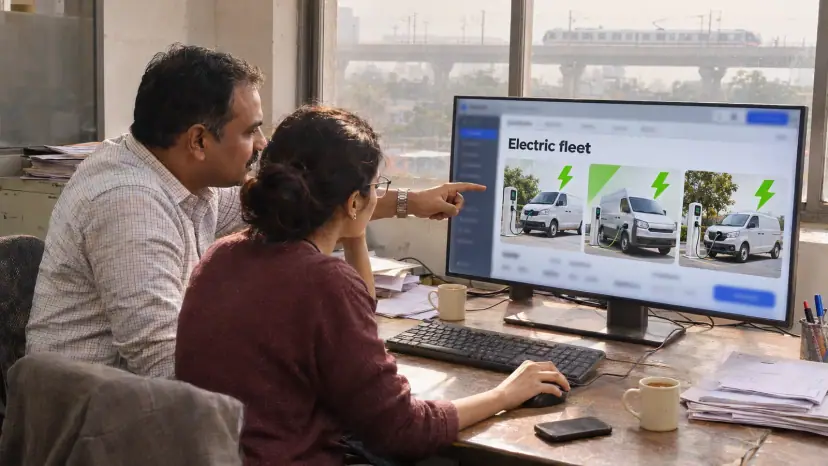
Evidence first: handling charging and energy enquiries for Delhi sites
Teams selling EV charging or energy projects get questions that sound simple and rarely are. Is this connector compatible? Can this site take a charger? This guide helps EV and Clean Energy teams in Delhi answer from evidence, by setting out what to collect, the local source to consult, the assistant's limits and the approval points. We present these workflows for planning, and they are not reported Brainguru client results. Scope follows what your charging or energy business really does, the data it holds and the permissions it has.
Keeping Delhi separate from the wider NCR
Delhi is one scope and the wider NCR is another. Noida and Gurugram come under different state administrations, so their addresses must not sit with your Delhi ones. To find the office tied to an actual Delhi address, use the Revenue Department district resources.
You can look this up at Delhi Revenue Department, which supports administrative context only. It does not establish demand or commercial availability, and no private charging business gains an endorsement from it. Write down the Delhi district and locality, list NCR locations separately, then match the result to the approved business record. A reviewer resolves any conflict before directions, coverage information or an appointment instruction appear on a page or in an assistant.
What each Delhi project or charging brief must contain
Use these fields as a working brief. Publishing a city name beside an unrelated national offer does not do that job. Connect each statement with its source and its reviewer. If a value is unavailable, send the gap to someone on the team, because assumptions from the model are not acceptable here.
- Actual proposed site and operating location: Record the Delhi district and locality of the site, listing NCR locations separately, and go by the operating address, not the advertising audience.
- Vehicle/charger/system model: Specify which vehicle, charger or energy system is involved, with its limits and a current reference.
- Approved technical compatibility evidence: Point to approved proof of compatibility, and treat any detail you still lack as a matter for review.
- Site/electrical prerequisites: Retain the approved evidence for site and electrical requirements, in its current version, as no photo or city name can show them.
- Installation or charging-use enquiry: Distinguish installation from charging use, record what next step is wanted and set apart anything unsupported or misrouted.
- Qualified technical reviewer: Identify the qualified reviewer who can confirm the answer or action before the customer sees a next step.
Take a hypothetical Delhi request. A commercial or professional next step comes only after it passes the location check and the vehicle, charger or system model check. If it fails, the handoff keeps it unresolved and the receiving team has a concrete question to answer, not a lead falsely marked as qualified.
How AI supports the technical review
Each enquiry needs a clear use case. It may be a vehicle charging question, a charger installation, fleet charging or a separate energy-system project. AI gathers requirements and retrieves approved technical information, and a qualified reviewer checks site and electrical prerequisites. Do not treat a map entry or marketing photo as evidence that a charging point is currently available or compatible.
Connections are limited to what has been authorised, namely an approved knowledge pack, the relevant operational system and, if needed, a CRM or intake route. Store the source version for every answer on compatibility or site needs. Test access permissions and revision rights ahead of live customer data. Reviewers can use drafts, predictions and extracted fields as aids, and these never amount to an automatic commercial commitment.
As a planning example, a housing society asks whether it can install chargers in its parking area. The assistant records the number of parking spaces, the kind of vehicles, whether the society has a committee decision and what the electrical connection is. A qualified reviewer then checks the site and the supply. The assistant does not say whether the building can take a charger. The society hears what the reviewer found and what remains uncertain.
In the first weeks, note which prerequisites the reviewer most often found missing, such as parking rights or supply capacity. Ask for those details in the first reply, so fewer enquiries stall at the site review.
Claims on range, payback and subsidies
Without current evidence specific to the project, do not promise range, charging speed, payback or subsidy eligibility. A site and technical review must come before a commercial commitment. Grant or incentive resources are not part of an approved installation quote. An assistant must not certify a connection, an installation or a government benefit.
The Delhi Transport Department site has a Delhi EV policy page and centralized operating guidelines for it, alongside vehicle registration and permits. Do not describe from memory what the policy offers a buyer or an operator. When a page mentions it, quote the department's current wording through your compliance contact and date the check. The site does not say whether any particular vehicle or charger qualifies, so an assistant should leave that to a person who can read the current documents.
Hindi and English, search presence and measured stages
Competent speakers should check terminology, locality names and the proposed next step if the audience needs Hindi and English. Assess these options with the business, since not every customer uses them and we do not supply every translation. Show the real address and a steady contact route on the page and in business records. Never make extra offices or profiles to simulate local presence.
Audience location in Delhi and the location of the work can differ, so record each. Project pages and routing follow the approved serviceable area. Track the stages independently: technical enquiry → compatibility/site review → scoped proposal → approval → implementation. Rejected, cancelled and unsupported requests remain in your evaluation, as a click or chat is not revenue.
Tests should include an incompatible connector, unavailable power capacity, an unverified charger listing and a subsidy question lacking current evidence. Compare what reviewers found with the supplier's own baseline ahead of extra spend. Read search queries for mismatched intent, then improve the relevant answer or handoff. Rankings, AI-answer inclusion, lead volume and return on investment come with no guarantee.
Related material and getting in touch
Go to EV & Clean Energy solutions for the scope of this industry and AI Visual Inspection for Automotive Components: Measuring Missed Defects and False Rejects for implementation detail. The article deals with a related workflow, so it does not evidence a Delhi client engagement.
Delhi teams may also want Automotive or Manufacturing. Official references and supported information for each location appear in Delhi and other city guides.
At a free consultation, we would want to see the actual proposed site and operating location, the vehicle, charger or system model, approved source material and the reviewer who decides the next step. Our Noida office handles delivery, and we do not say we have a Delhi branch. Scope, integrations and any on-site work are reviewed by case.
The local and sector resources were checked on 5 October 2026, and instructions should be reread before campaign changes. Images are illustrative of the topic and are not verified photographs of local offices, customers or facilities.