Agra EV and clean energy enquiries backed by evidence
What does this vehicle, charger or site really support? An Agra enquiry about charging or an energy project needs an answer based on evidence. This guide is for EV and Clean Energy teams serving the city. It shows what to collect, which local source to consult, what an assistant may do and where a person must approve the next step. We offer the workflows as planning examples, and they are not reported Brainguru client results. Scope depends on your actual business, data and permissions.
Agra's tourism listings are not commercial permission
The Agra district portal carries tourism and administrative resources. Treat an Agra attraction, an accommodation address and a supplier's registered premises as three separate things. A tourism reference gives destination context, but it grants no commercial permission and endorses no service provider.
Read Agra district before anything else. It is a source of local administrative context only. Market demand, commercial availability and endorsement of private firms are outside what it can show. For this EV and Clean Energy workflow, record the Agra site, the visitor destination and the premises separately, then match the location to the approved business record. If these disagree, a reviewer resolves it before the page or assistant gives directions, coverage information or an appointment instruction.
Facts to gather for an Agra charging or energy enquiry
Work through these fields as a brief, so the page does more than place a city name beside an unrelated national offer. Tie each statement to the source and reviewer behind it. Unavailable information is recorded as a gap and goes to a person. The model never fills it with an assumption.
- Actual proposed site and operating location: Record the proposed site and where the business operates, keeping the Agra site, visitor destination and premises separate. Use the actual address, not the advertising audience.
- Vehicle/charger/system model: Name the exact vehicle, charger or system model the question concerns, with the limits and current reference for what is supported.
- Approved technical compatibility evidence: Note what approved evidence shows about compatibility. Missing details remain questions for the technical review.
- Site/electrical prerequisites: Keep the approved, current evidence of site and electrical prerequisites on file. A photograph or city name cannot show them.
- Installation or charging-use enquiry: State whether the person wants installation or charging use, the next step and the details needed. Separate unsupported or misrouted requests.
- Qualified technical reviewer: Identify the qualified person who can confirm the answer or action before the next step is offered.
An illustrative Agra request needs to pass two checks, location and the vehicle, charger or system model, before a commercial or professional next step is put forward. Failing either leaves the handoff unresolved. The receiving team gets a concrete question to answer and avoids a falsely qualified lead.
Sorting charging questions from energy projects with AI
First work out which use case you have: a vehicle charging question, charger installation, fleet charging or a separate energy-system project. AI can collect requirements and retrieve approved technical information. A qualified reviewer then checks site and electrical prerequisites. Neither a map entry nor a marketing photograph shows that a charging point is available now or that it is compatible.
Connect the sources and systems the business has authorised and no others: an approved knowledge pack, the relevant operational system and a CRM or intake route where one is needed. Write down the source version each answer used. Test access permissions and content-revision rights before using live customer data. A draft, prediction or extracted field can aid the reviewer, and that is all. It is no automatic commercial commitment.
The district How to Reach page describes road links from Agra to Delhi, Jaipur, Gwalior and Lucknow. It dates from 2019 and is written for travellers. It tells you nothing about charging demand or equipment. If your enquiry is about charging for visitors or longer drives, it is context at most, and the real work is the site review.
Suppose a guesthouse owner asks about adding a charger for guests. The assistant records the property's location, the parking layout, the vehicle models guests are likely to bring and who owns the building. It does not say that a charger will fit or what it will cost. A qualified reviewer checks the electrical capacity and safe placement, and the proposal lists approvals the owner must obtain. Guest demand is not assumed anywhere in the record.
Promises an EV or clean energy page cannot make
Range, charging speed, payback and subsidy eligibility cannot be promised without current, project-specific evidence. A commercial commitment has to follow a site and technical review. Keep grant or incentive resources apart from an approved installation quote, and do not let an assistant certify a connection, an installation or a government benefit.
Give each step an owner. The site reviewer owns the electrical findings, sales owns the proposal and one person owns the compatibility list and its dates. In the first weeks, count the enquiries that stopped at the site review. If many did, the page should say plainly what a site needs, so people can check before they enquire. A pattern of connector mismatches means the compatibility list should be fixed before more is spent on promotion.
Hindi, local search and tracking a project to implementation
Hindi and English may suit your audience. If so, have competent speakers review terminology, locality names and the proposed next step. Assess those options with the business, without assuming every customer uses them or that we supply every translation. Keep the actual address and contact route consistent on the page and in business records, and do not create offices or profiles to simulate a local presence.
The location of an Agra audience may differ from where the installation or service takes place, so keep them apart. The approved serviceable area should shape both page content and enquiry routing. Follow each stage on its own: technical enquiry, compatibility and site review, scoped proposal, approval, implementation. Rejected, cancelled and unsupported requests stay in the evaluation, since a click or conversation is not revenue.
Test it with an incompatible connector, power capacity that is unavailable, a charger listing nobody has verified and a subsidy question with no current evidence. Compare reviewed outcomes with the business's own baseline before increasing spend. Inspect search queries for mismatched intent and work on the answer or handoff affected. We can offer no guarantee on rankings, AI-answer inclusion, lead volume or return on investment for an energy project.
What to read next, and what to bring to a consultation
EV & Clean Energy solutions covers industry scope, and AI Visual Inspection for Automotive Components: Measuring Missed Defects and False Rejects offers implementation detail. The article explains a related workflow, so it is not evidence of an Agra client engagement.
Agra planning pages also cover Automotive and Manufacturing. Agra and other city guides let you weigh supported information and official references across places.
Book a free consultation and bring the actual proposed site and operating location, the vehicle, charger or system model, approved source material and the reviewer who can decide the next step. Our delivery is from Noida, with no claim to an Agra branch. Integrations, scope and any on-site work get discussed case by case.
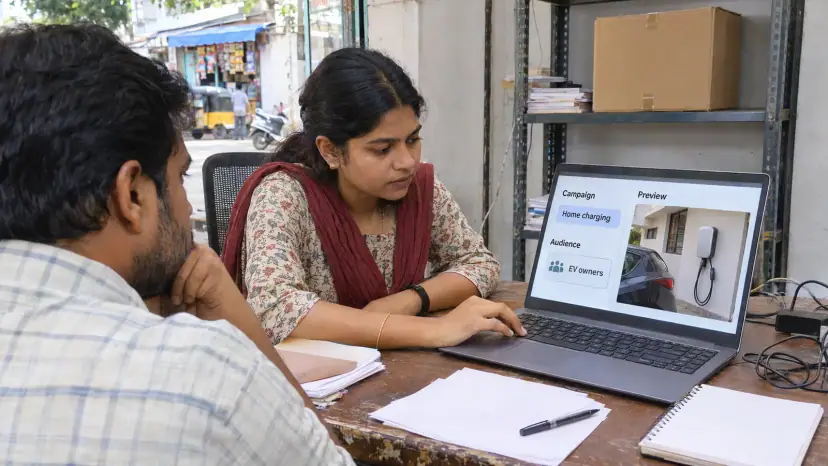
We looked at the local and sector resources on 5 October 2026. Campaign changes should wait for a fresh look at current instructions. Photographs here are topic illustrations, not verified photographs of local offices, customers or facilities.