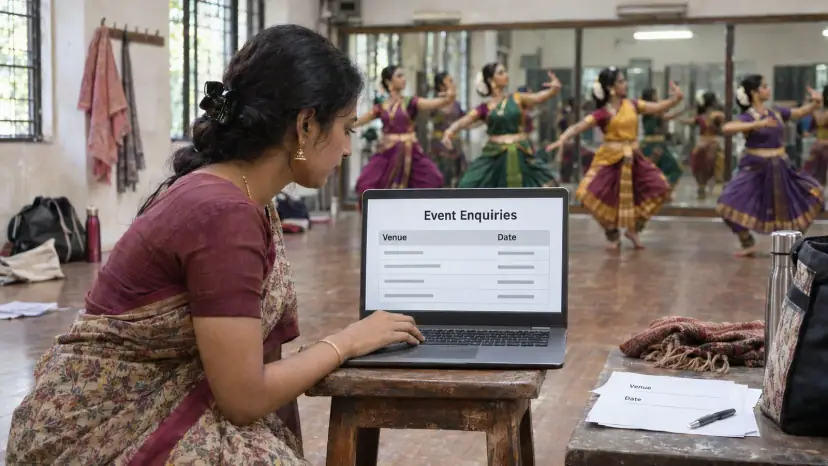
Promoting Bhubaneswar events and content without overstating rights
Promoting a show or a release means knowing you hold the rights and that the event details can be verified. This guide is for Entertainment and Media teams serving Bhubaneswar who want rights-aware content promotion and event enquiries that stand up to checking. It lists what to collect, the local source to consult, what an assistant can do and what a person must approve. The workflows are planning examples and report no Brainguru client results. Service scope comes from your actual business, data and permissions.
Keeping the Bhubaneswar venue distinct from Khordha and Odisha
According to Bhubaneswar Municipal Corporation's official profile, the city is in Khordha district. Your city operating address and the wider district should stay separate. An audience in the state capital is not coverage throughout Odisha.
Bhubaneswar Municipal Corporation is your first reference. It can supply local administrative context, but it says nothing about market demand or commercial availability and does not endorse private businesses. For this Entertainment and Media workflow, keep separate entries for the Bhubaneswar site and the wider Khordha district, and compare the location with the approved business record. A reviewer settles any mismatch before the page or assistant offers directions, coverage information or an appointment instruction.
The brief for a Bhubaneswar event or licensing enquiry
Use these fields as a working brief. They stop a city name from being published beside a national offer it has nothing to do with. Keep every statement linked to a source and a reviewer. Missing information becomes a logged gap for a person, never a guess by the model.
- Actual venue or production contact: Name the real venue or production contact, with the Bhubaneswar site and wider Khordha district listed separately. Use the operating address, not the advertising audience.
- Event/content identity and dates: State exactly which event or content is on offer and its dates, with its limits and current reference.
- Rights/permission status: Record whether rights or permissions are cleared and what is needed to check that. Unknowns stay questions for review.
- Approved schedule and availability source: Keep the approved schedule in its current version with the record. A photograph or city name does not prove availability.
- Booking/licensing enquiry type: Separate booking requests from licensing ones, note the next step and the information needed, and set aside unsupported or misrouted requests.
- Producer/venue reviewer: Name the producer or venue person who confirms the answer or action before the next step is offered.
Say an illustrative Bhubaneswar request arrives. Until it passes both the location check and the event or content identity and dates check, nobody should suggest a commercial or professional next step. If a check fails, the handoff carries it as an open item. The receiving team then gets a real question to answer, and no falsely qualified lead.
The Odisha Tourism site carries an upcoming events section and festival and cultural pages for the state. A team can read it to see how official bodies describe events. A listing there does not confirm that your event is licensed, scheduled or sold out, and your page should not borrow its wording as proof. Your event record needs its own confirmed date, venue and permission, kept by the promoter.
Using AI on promotion while keeping rights and bookings in human hands
Media promotion should lead an audience question to the actual event, content release or permitted licensing offer. AI can organise enquiries, or draft material for review from rights-cleared assets. Interest in an event is one signal. An available ticket, a confirmed booking and a content licence are different things, so record them apart. Putting a city name in a trailer description does not establish a venue booking or a local production partnership.
Keep integrations to what the business has authorised: an approved knowledge pack, the relevant operational system and a CRM or intake route where needed. Write down the source version used for each answer. Test access permissions and content-editing rights before live customer data is involved. A draft, prediction or extracted field helps the reviewer and creates no automatic commercial commitment.
Follow one licensing enquiry. A small channel asks whether it may screen a short film at its own event. The assistant does not answer yes or no. It records the title, the use and the dates, and flags that a screening licence depends on who holds the rights. The rights owner or their agent replies. If the channel hears nothing for days, the log shows that the question is still open.
What entertainment and media pages must never invent
Never invent cast participation, venue confirmation, audience figures or rights ownership. Images and music must be authorised, and synthetic or illustrative assets should be labelled as such. When an enquiry involves an event permit or a content-rights question, the responsible professional confirms it before any commercial commitment.
Odia, search and following an enquiry to completion
Where Odia and English are needed, competent speakers should review terminology, locality names and the proposed next step. Talk these options through with the business. We do not say that every customer uses them or that we supply every translation. Use the actual address and a consistent contact route on the page and in business records, and do not create offices or profiles to simulate local presence.
Audience location in Bhubaneswar and the place where the event or service is fulfilled need separate treatment. The approved serviceable area should decide page content and enquiry routing. Track independently: content or event enquiry, schedule and rights review, available offer, booking or licence, completion. Leave rejected, cancelled and unsupported requests in the evaluation, as a click or conversation is not revenue.
Test the flow against an unconfirmed venue, a withdrawn release date, missing image rights and a ticket category that is unavailable. Compare reviewed outcomes with the business's own baseline before spending more. Inspect search queries for mismatched intent, then improve the answer or handoff they reach. Neither a promoter nor a media team gets a guarantee of rankings, AI-answer inclusion, lead volume or return on investment.
Decide who owns the ticketing partner relationship. Sales figures, refunds and entry rules come from the ticketing system, and a promoter has to relay them. When no one owns that link, the assistant quotes ticket availability from last week. Name the person who updates the event record after each ticketing change.
Early on, compare the questions people ask before an event with those after it. After-event questions about refunds or access need an answer in the pre-event copy, not another campaign.
Where to look next, and what to have ready
The scope for this industry is on Entertainment & Media solutions. For implementation detail, AI Consulting for Indian Enterprises (2026): What It Should Actually Deliver covers a related workflow. It does not show any client engagement in Bhubaneswar.
Bhubaneswar planning pages also exist for Travel & Hospitality and SaaS. Bhubaneswar and other city guides help you compare supported information and official references.
When you ask for a free consultation, have the actual venue or production contact, the event or content identity and dates, approved source material and the reviewer who can decide the next step. Delivery comes from Noida, and no Bhubaneswar branch is claimed. Scope, integrations and on-site work are decided per case after discussion.
Local and sector resources for this guide were checked on 5 October 2026, so look again at current instructions before changing a campaign. Photographs illustrate topics and are not verified pictures of local offices, customers or facilities.