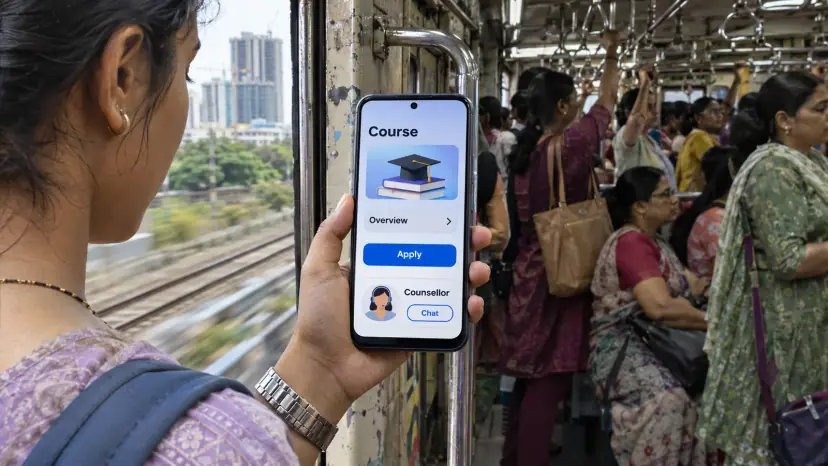
AI marketing for education and EdTech in Mumbai: the useful part
Learners and parents in Mumbai want course details they can rely on, and admissions staff want enquiries that a counsellor has actually reviewed. AI marketing for education and EdTech in Mumbai serves both when it stays modest. This guide lists what to collect, which official pages to consult, what an assistant may say and where a person approves.
Each admissions workflow below is a planning example, not a Brainguru client result. We shape each service around the institution's real business, data and permissions. Nothing here promises an admission, a pass mark, a rank or a job.
Mumbai City district and the addresses you publish
Mumbai City runs its own district administration under the Government of Maharashtra. The source to check is Mumbai City district. It gives administrative context only: it says nothing about market demand or commercial availability, and it endorses no private institution. Its home page is written in Marathi and recalls that the city's official name was Bombay until 1951.
The portal gives the district's area as 157 sq km and lists one municipal corporation. Parel-Sewri, Malabar Hill and Girgaon appear as revenue divisions in its land-record notices, and the portal also carries the list of Aaple Sarkar Seva Kendra centres. Because it covers one district, do not treat it as a directory for every address marketed under the Mumbai name.
For each campus or counselling desk, note the actual locality and whether it falls in Mumbai City district or elsewhere, and compare that with the approved business record. A reviewer settles any disagreement between them; until then, neither the page nor the assistant offers directions, says which area a desk covers or books an appointment.
Six things to record in a Mumbai admissions enquiry brief
A city name beside a national offer tells an applicant nothing. Use the six fields below as your working brief, keep every statement tied to a source and a reviewer, and treat a missing fact as a gap for a person to fill.
- Campus address and delivery mode: Note the locality where teaching really happens and whether the course is on campus, online or blended, judged by where you teach rather than whom you advertise to.
- Course and academic-session identity: Pin down the exact course and its session, using the current reference, so that nobody answers about the wrong intake.
- Approved eligibility and fee-information source: Capture which approved source gives the eligibility and fee details; whatever it leaves out remains a question for review.
- Recognition/accreditation evidence where applicable: Attach the current version of the approved evidence, as a campus photograph or city name cannot establish recognition; for an online or distance programme, keep the record that covers that mode and session.
- Adult contact or parent/guardian channel: Show whether a working adult, a parent or a school pupil is writing, and the channel the enquiry came through.
- Admissions-review owner: Identify the Mumbai admissions officer who signs off each reply before a next step is offered.
A sample Mumbai enquiry passes the location check and the course and session check before anyone mentions fees or a seat. A failed check is carried into the handoff as unresolved, so admissions gets something concrete to answer.
Supporting counsellors without replacing them
The assistant can bring up an approved course guide, spot which details are still missing and prepare a summary for the admissions counsellor. It records an enquiry, a booked counselling slot, a submitted application and an enrolment as four different things. A person asking about an online programme must not be steered to a campus visit just because they searched with a city name.
Hook up nothing beyond what the institution has cleared. For a Mumbai admissions team that is its approved course knowledge, the admissions software and, if used, a CRM or intake route. Write down the source version behind each answer, and test permissions before any live student or parent data is used. For the reviewer, a draft or a predicted score is an aid; it never amounts to a commercial commitment.
Here is a planning example. A working professional asks on a weekday evening whether a certificate course has a seat this term. The assistant looks up the approved session list, sees that the intake it holds is for the previous term and says so. It offers no seat. It passes the counsellor the course, the mode asked about and a note that the intake source is out of date. Someone in admissions has to own that list; if nobody does, the assistant will keep quoting a closed term.
Online and distance programmes: what UGC publishes
One independent sector reference is the University Grants Commission. If your learners study part-time, the online question matters. When opened on 5 November 2026, the UGC home page carried a public notice inviting applications from eligible institutions for recognition to offer programmes in Open and Distance Learning mode or Online mode, for the academic session beginning January-February 2027. It also links a Distance Education Bureau portal.
Read that notice and the related regulations afresh, and get the responsible professional at your institution to review whether they apply to the programme you plan to promote. Then publish only what your records show for that mode and that session. The same home page invites students and parents to verify the authenticity of higher educational institutions before admission, which is a reasonable step to mention on a course page.
Leave out recognition, placement rates, salary outcomes and deadlines that your records cannot back. Leave out student testimonials, rank lists and phrases such as "assured admission". A countdown is fair only when admissions has published the date and someone keeps it current.
Notices, age checks and the DPDP Rules
The DPDP Rules, 2025 appeared on 13 November 2025, and under their rule 1(4) the main Data Fiduciary duties wait a year and a half, to 13 May 2027. Rule 3 sets out the notice: an itemised description of the personal data, the specified purpose, and a way to withdraw consent that is as easy as giving it, along with how to exercise rights and complain to the Board.
For a pupil, rule 10 asks for verifiable consent of the parent before any personal data of the child is processed. Rule 12 and Part B of the Fourth Schedule exempt one narrow purpose from those child-data conditions: confirming that a person is not a child, to the extent necessary. So an evening-course form can ask one plain question about age and send under-eighteen enquiries to a parent route, without collecting more than that.
Marathi, Hindi and English pages, listings and the admissions path
Mumbai audiences may need Marathi, Hindi and English. Where they do, competent speakers should go over course names, locality names and the next step. This is something to assess with the institution, not a statement that all applicants use these languages or that we provide all the translation. Print one true address and one contact route on the page and in every business record; no made-up offices.
Keep the learner's location apart from the place the course is delivered. Give each step its own column in the report: the enquiry, the counsellor's review, the application, the decision and the enrolment. Rejected, cancelled and unsupported requests stay in the evaluation, because a click or a conversation is not revenue.
Try the workflow with a different campus, an expired admission notice, an online course with no record for the mode and a message from a minor. Look at reviewed outcomes next to the institution's own baseline before spend goes up. No one can promise a Mumbai institution a ranking, a place in AI answers, a set number of leads or a return, and we do not.
In the first weeks, count how many enquiries reach a counsellor with the course and session already filled in. If many arrive without them, change the form or the assistant's questions before you change any advertising. If you are building the assistant itself, our AI chatbot development page explains the build options.
Continuing your Mumbai admissions planning
Sector scope is covered on AI Marketing for Education. How such a project is put together is the subject of AI Consulting for Indian Enterprises (2026): What It Should Actually Deliver; it deals with a related workflow and shows no Mumbai client. Online course businesses may also want AI Marketing for EdTech.
Other tasks you can plan for Mumbai appear under AI Marketing for SaaS in Mumbai and AI Marketing for HR and Recruitment in Mumbai. To compare supported information and official references with other cities, see Mumbai and other city guides.
Ahead of a free consultation, have ready the teaching locality and mode, the precise course and intake, your approved prospectus and fee sources and the name of the person who approves replies. Noida is where we deliver from, and no Mumbai branch is claimed. Scope and integrations are discussed for each institution.
Checks on the local and sector resources were made on 5 October 2026 and again on 5 November 2026, so look again at current instructions before a campaign changes. Photographs only illustrate the topic and are not verified images of local offices, students or facilities.