AI marketing for BFSI (Banking and Finance) in Agra: recovery calls, fraud and servicing
AI marketing for BFSI (Banking and Finance) in Agra is not only about new loans: borrowers also write when a recovery visit worries them or a call looks like fraud. This guide shows BFSI (Banking and Finance) teams how to plan for that, from the record to the point where an officer takes over.
Read every workflow here as a plan on paper. None reports a Brainguru client. Nothing in it is investment, credit or insurance advice; public wording is the lender's call, made through its compliance officer, and scope follows your business, data and permissions.
Agra on the district portal, and what to keep apart
The Agra district portal is the source to read before anything else. Treat it as local administrative context, which is not proof of market demand, of commercial availability or of support for a private business. It is the portal of District Agra, Government of Uttar Pradesh, with a Hindi version.
The About District text puts Agra on the Yamuna and gives two distances: New Delhi lies 206 km to the north, and Lucknow, the state capital, 378 km to the east. It names the Taj Mahal, Mughal history, traditional handicrafts and Petha as what the district is known for. Our 5 November 2026 reading of the District at a Glance figures showed an area of 4027 sq km, 6 tehsils, 15 blocks, 690 gram panchayats and 47 police stations, with Hindi listed as the language.
The Agra district portal carries tourism and administrative resources together, including online ticket booking for monuments and a District Industrial and Investment Profile. Tourism material gives destination context, but it grants no commercial permission and endorses no service provider. A recovery or loan message should never borrow a monument or a government profile to look official.
Keep three things apart in the record: the borrower's village or ward, the branch that serves the loan and the place agreed for repayment meetings. These can differ, and the RBI rules below turn on the last one.
The enquiry brief for an Agra finance team
Keep every statement linked to where it came from and who reviewed it. Anything missing is logged as missing and passed to a colleague, never guessed by the model.
- Regulated provider identity: Name the regulated entity behind the product and its actual operating address, with the borrower's locality and the branch kept apart.
- Actual branch or service channel: State which branch, servicing desk or field team handles this task, what it can support and how current that reference is.
- Approved product-information version: Record which version of the recovery and grievance wording was used. If you cannot confirm the version, treat the answer as a question for review.
- Eligibility information source: Keep the approved document that explains eligibility for new loans, in its current version, with the record. A photograph or a city name proves nothing here.
- Application enquiry type: Note whether this is a new loan, a servicing question, a recovery complaint or a suspected fraud, and separate misrouted requests.
- Authorised reviewer: Record which officer signs off the reply or action, so nothing reaches the borrower unchecked.
Recovery conduct for microfinance loans in the RBI Directions
Never hint that a private lender carries RBI backing, never promise that a loan will be sanctioned and never turn a quoted return into a pledge. Agra lenders can treat the Reserve Bank of India as the sector reference that no lender controls; check the current text on its official website, which also lists amendment directions and circulars withdrawn.
How finance companies recover microfinance loans is governed by Sections H.4 and H.5, found in the RBI (Non-Banking Financial Companies - Responsible Business Conduct) Directions, 2025. Banks work to their own version. Four paragraphs matter for an Agra assistant:
- Paragraph 90: recovery is made at a designated or central place agreed by the borrower and the lender; field staff may go to the borrower's home or workplace only if the borrower fails to come on two or more successive occasions.
- Paragraph 91: harsh methods are banned, among them threatening or abusive language, persistent calls or calls before 9:00 a.m. and after 6:00 p.m., harassing relatives, friends or co-workers, publishing borrowers' names, and misleading a borrower about the debt.
- Paragraph 92: the lender has a dedicated mechanism for recovery-related grievances, and its details are given to the borrower at disbursal.
- Paragraph 94: recovery agents are engaged only after due diligence, including antecedent and police verification of the individuals involved.
So an assistant can tell a borrower what the lender's recovery rules say, where the grievance mechanism is and how to reach the nodal contact. It must never judge whether a particular agent broke the rules, threaten consequences or discuss the amount overdue. An officer takes over every complaint.
What the assistant may retrieve and what it must never decide
The assistant reaches only what the lender has cleared, such as its approved knowledge pack, the servicing system and a CRM or intake route if one is in use. Every answer should carry a note of its source version, and access permissions are tested before live data is used.
Plan for fraud attempts in any finance enquiry channel. The assistant should never ask for an OTP, PIN or card number in chat, and its opening line should say so. If a customer reports a suspected fraud, the assistant stops answering and hands the case to an officer, who can point the customer to the official reporting routes. Our article on cybersecurity for Indian SMEs covers the basic controls a smaller lender should have in place first.
Here is one example for planning. A customer writes in Hindi that a loan instalment was debited twice. That is servicing, not a sales enquiry. The assistant routes it to the servicing desk with the message intact and does not start a product sequence. Another borrower writes that a recovery agent came to their shop at night. The assistant gives the approved grievance route under paragraph 92, logs a complaint and alerts the officer the same day.
Access control and breach advice under the DPDP Rules
For an Agra lender, complaint texts, phone numbers and repayment details fall within the Digital Personal Data Protection Act, 2023 as personal data. Most Data Fiduciary duties in the DPDP Rules, 2025, whose Gazette date is 13 November 2025, take effect on 13 May 2027, the start date set by rule 1(4).
Access is the subject of rule 6(1)(b), which wants measures controlling access to the computer resources the lender or its processor uses, so recovery complaints should be visible only to the officers who handle them. If those records leak, rule 7(1)(d) says each affected person must be told the safety measures they can take, such as ignoring calls that ask for an OTP.
Hindi and English, local search and tracking the handoff
The portal lists Hindi. Where borrowers write in Hindi or English, have a fluent reviewer check the terms, place names and next step in each reply. Under paragraph 10 of the RBI Directions, a borrower must receive communications in the vernacular or a language they understand, a reply to a recovery complaint included. Which languages to offer is decided with the lender; this is no claim about every borrower's language, and Brainguru does not promise every translation.
One real address and one contact route should match everywhere the lender is listed, with no extra profiles made to seem local. Our BFSI technology solutions page explains how such servicing channels can sit beside the lender's core systems.
Track four stages independently: question answered, branch or desk matched, officer contacted, then a resolved complaint or a new application. Leave rejected, cancelled and unsupported requests in the count. Test a complaint about a night-time visit, a borrower who missed two meetings and a message asking for an OTP. Whatever the tests show, nobody can promise a ranking, AI-answer mentions, lead numbers or a return, so judge the reviewed results against how the lender was doing before launch.
Next steps for Agra finance teams
Industry scope lives on AI Marketing for Fintech. The build itself is walked through in the article AI Marketing for Fintech in India: A Compliance-Ready Playbook, which covers a related workflow and points to no Agra client.
Agra also has planning guides for AI Marketing for Fintech in Agra and AI Marketing for Insurance in Agra, and Agra and other city guides let you compare their sources.
Ahead of a free consultation, gather the name of the regulated lender, details of its servicing desk and field teams, the approved recovery and grievance wording and the officer who decides the next step. We deliver the work from Noida, and there is no Agra branch to claim. Scope and integrations are decided for each case.
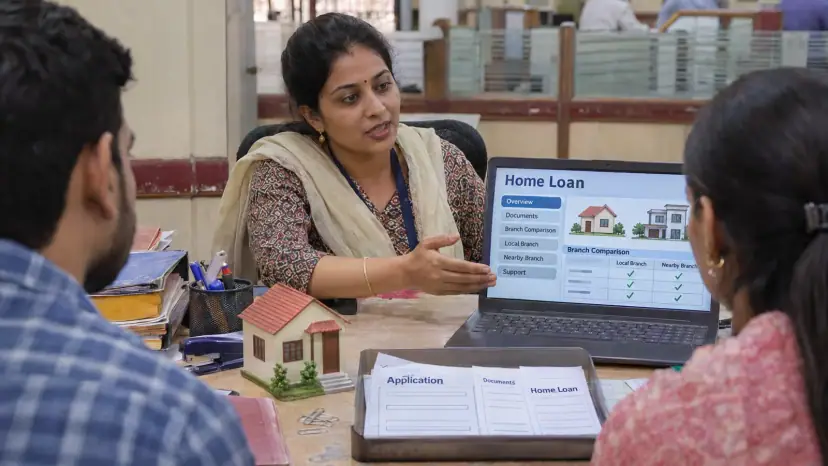
The Agra portal and the sector pages were read by us in two passes, the first on 5 October 2026 and the second a month later on 5 November 2026. Look at the current instructions again before a campaign changes. Photographs are illustrations of the topic, never photographs of local offices, customers or facilities.