Kolkata commodity enquiries that keep lots and market data straight
Agriculture and AgriTech teams serving Kolkata often get questions about one specific lot, plus requests for market information. This guide shows how to handle both with AI and keep every answer sourced. It lists the details to gather, the local source to check, the assistant's permitted tasks and the step where a person approves. The workflows are planning examples, not results reported by a Brainguru client. Each service is scoped to what your agriculture business actually does, the data it holds and the permissions it has.
Locality and district are separate fields in Kolkata
Metropolitan audiences cross municipal boundaries, so the locality a customer sees and the documented district should each have their own field. The Kolkata district portal is a place to begin for administrative contacts. For the premises themselves, use whichever source is correct.
Begin at Kolkata district, which offers administrative context only: it cannot establish market demand or commercial availability, and it does not endorse any private business. Enter the Kolkata premises and the actual district, then check them against the approved business record. Where those differ, a reviewer sorts it out before the page or the assistant gives directions, coverage information or an appointment instruction.
A working brief for each Kolkata lot enquiry
These fields keep the page honest, as opposed to a national offer with Kolkata added to it. Every statement needs a source and a reviewer beside it. Log any missing information and hand it to a person, and do not allow the model to assume an answer.
- Actual farm, seller or collection location: Enter the Kolkata premises and the actual district from the operating address, whatever area the advertising targets.
- Commodity, grade and lot identity: Identify the lot precisely, by commodity and grade, because buyers are asking about that lot and not the crop in general.
- Quantity and availability source: Enter the quantity asked for and where availability is confirmed; gaps stay open as review questions.
- Dated market-information reference: File the approved reference with its date and version, as a city name or a photograph is not evidence of a market position.
- Buyer delivery/export question: Record exactly what the buyer wants to happen on delivery or export, and flag requests you cannot support or that reached the wrong desk.
- Seller/technical reviewer: List the person able to confirm this lot's answer, so the next step waits for them.
As an illustration, suppose a Kolkata request comes in. It has to pass on location and on commodity, grade and lot identity before a commercial or professional next step is mentioned. Anything that fails is handed over as unresolved. Instead of a falsely qualified lead, the receiving team sees the exact question it must answer.
Where AI helps with buyers, and where review takes over
Good answers depend on five details: commodity, lot, grade, quantity and the collection or delivery location. With those in hand, AI can arrange buyer questions and fetch approved product information. It cannot turn a dated market reference into a seller's current quote. Different reviewers and evidence apply to input-sales questions, produce procurement, agritech demonstrations and export enquiries, so they should not share a queue.
Only authorised sources and systems get connected. That normally means an approved knowledge pack, the relevant operational system and, if required, a CRM or intake route. Each answer should carry the source version it used. Run tests on access permissions and on who can revise content, and do this before live customer data is involved. Drafts, predictions and extracted fields support the reviewer and are never automatic commercial commitments.
What agricultural pages must not promise
Stay away from promises on yields, pest-control outcomes, export acceptance or subsidies. Crop advice and product-use claims call for an appropriately qualified source. APEDA material concerns the agricultural and export functions it supports, and it should not read like blanket approval for seafood or for all commodities. Readers should still be able to see the real lot evidence and current seller terms.
An independent reference for the sector is APEDA official resources. Check that the instructions are current, then have the responsible professional review how they apply to the proposed activity.
Bengali and English, local search and tracking stages
Bengali and English may both be needed. If so, competent speakers should go through the terminology, locality names and proposed next step. We see these as language options to assess together, which does not mean every customer uses them or that we supply each translation. Keep the true address and one contact route consistent across the page and your business records, and do not create extra offices or profiles to fake a local presence.
Someone can be in Kolkata while the requested service is fulfilled elsewhere, so hold those two locations apart. The approved serviceable area sets what the page says and how enquiries are routed. Each stage gets its own count: commodity enquiry → lot/grade review → quantity/location confirmed → quote → fulfilment. A click or a conversation does not equal revenue, and rejected, cancelled and unsupported requests belong in the evaluation.
Good test cases are an unconfirmed grade, a stale price reference, a seafood export enquiry and a product-use question needing expert review. Set the reviewed outcomes against the business's own baseline before spend goes up. When search queries reveal mismatched intent, improve the answer or handoff involved. Rankings, AI-answer inclusion, lead volume and return on investment all fall outside any guarantee we give on agricultural work.
A worked example, from a buyer's lot question to an agreed sample
This is a planning example, not a result. A buyer asks whether ten tonnes of one grade of a commodity can be supplied next month, and wants a price. The assistant records the commodity, the grade, the quantity and the delivery point. It checks the availability record for that lot. It shares the dated market reference with its date and says it is a reference, not the seller's price.
The seller reviewer then decides whether the lot can meet the quantity and the grade, and phones the buyer. A sample is agreed, with who pays for it and what the buyer will check. The final quotation comes from the seller after the sample is approved. If the buyer later asks whether the lot can be exported, the question goes to the technical reviewer with the destination named. The page never says the lot is export ready.
Next reading and what to bring us
Agriculture & AgriTech solutions gives the industry scope. Demand Forecasting for Indian Distributors: Data Requirements and Pilot Evaluation covers implementation detail for a related workflow, though it does not show any engagement with a Kolkata client.
Elsewhere in Kolkata, you could plan for Logistics & Supply Chain or E-Commerce. To compare supported information and official references across cities, open Kolkata and other city guides.
A free consultation works best with the actual farm, seller or collection location, the commodity, grade and lot identity, approved source material and the reviewer who can decide the next step. Our team serves Kolkata sellers from Noida, with no Kolkata branch claimed. We discuss scope, integrations and any on-site work case by case.
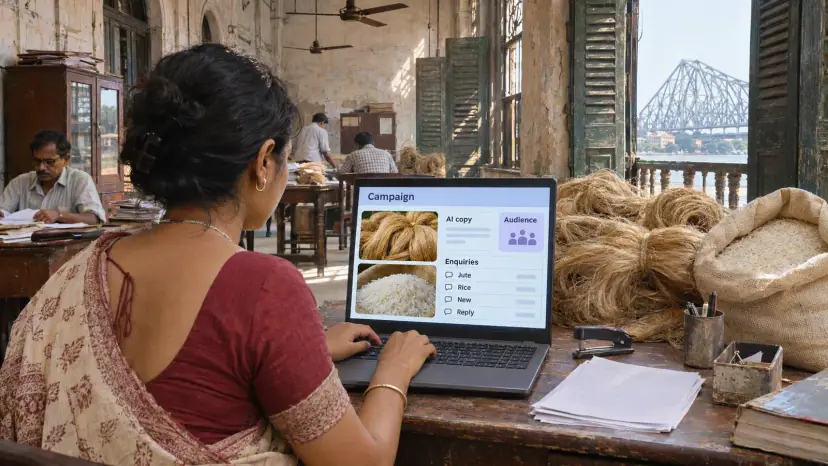
These local and sector resources were last checked on 5 October 2026, so look again at current instructions before a campaign changes. Any photograph here is an illustrative topic image and not a verified shot of a local office, customer or facility.