Answering Coimbatore buyers about a specific lot, with market information you can source
A buyer asking about a lot wants its grade, its quantity and where it is. A market figure only helps if you can say where it came from and how old it is. This guide is for Agriculture and AgriTech teams serving Coimbatore who deal with those questions. It covers what to collect, which local sources to check, what an assistant can do and where a person must approve the next step. The workflows are planning examples, not Brainguru client results. We scope each service around your real business, your data and your permissions.
Coimbatore city, the wider district and what the district sources can support
Coimbatore district resources include administrative and public-service information. Some enquiries are about the city and some are about the wider district, so note which one you have, along with where the facility is. The district’s published business context cannot tell you what one supplier can do or how much capacity it has today.
Your first reference is Coimbatore district. It gives administrative background only, so it cannot show market demand or commercial availability, and it endorses no private seller. Record the Coimbatore facility and whether the enquiry concerns the city or the district, then compare that with the approved business record. If they differ, a reviewer sorts it out before the page or assistant gives directions, coverage information or an appointment instruction.
The district’s Agriculture page can help you find the right department or regional context. A seller’s lot, grade, stock and price are separate matters, and you should not infer any of them from that page.
The brief to fill in before replying about a lot
Use these fields as your working brief, instead of putting a city name beside an unrelated national offer. Note the source and the reviewer for each statement. If something is missing, record the gap and pass it to a person. The model should never fill it with a guess.
- Farm, seller or collection location: Record where the lot actually is and whether that is in the city or the wider district. Use the operating address, not the advertising audience.
- Commodity, grade and lot identity: Name the commodity, the grade and the exact lot, because the buyer is asking about that lot and not the commodity in general.
- Quantity and availability source: Note how much is on offer and who supplied that figure. If you do not have it, it stays a question for the seller.
- Dated market-information reference: Keep the source and date of any market figure, so nobody mistakes it for the seller’s current quote.
- Buyer delivery or export question: Write down what the buyer asked about delivery or export, since export enquiries need a different reviewer and different evidence.
- Seller or technical reviewer: Name the person who can confirm the answer before any next step is offered.
Take an example Coimbatore request. It should pass the location check and the commodity, grade and lot check before anyone suggests a commercial or professional next step. If a check fails, mark it unresolved in the handoff. The seller then has a clear question to answer, and the enquiry is not mistaken for a qualified lead.
Where AI helps, and what stays with the seller
An agricultural enquiry needs the specific commodity, lot, grade, quantity and collection or delivery location. AI can organise buyer questions or find approved product information, but a dated market reference is never a seller’s current quote. Input-sales questions, produce procurement, agritech demonstrations and export enquiries should be kept apart, because each needs its own reviewer and evidence.
Connect only what the business has authorised: an approved knowledge pack, the relevant operational system and a CRM or intake route if needed. Log the source version behind each answer about a lot. Before you use live customer data, test who has access and who can change the content. Drafts, predictions and extracted fields help the reviewer, but they never commit the seller commercially.
What agricultural pages must not claim
Never promise yields, pest-control outcomes, export acceptance or a subsidy. Crop advice and product-use claims need a suitably qualified source. APEDA resources relate to the agricultural and export functions it supports, so do not present them as blanket approval for seafood or for every commodity. Keep real lot evidence and the seller’s current terms easy to see.
For an independent sector reference, see APEDA official resources. Check the current instructions there, and ask the responsible professional whether they apply to what you plan to do.
Tamil and English, local search and the stages to count
If your audience needs Tamil and English, ask competent speakers to review the terms, locality names and proposed next step. The seller can assess these options with us. We are not saying every customer uses them or that Brainguru supplies every translation. The seller’s real address and one contact route should match on the page and in business records, with no extra offices or profiles added to look local.
A buyer in Coimbatore may not be where the order is fulfilled, so keep those two locations separate. Let the area the seller has approved as serviceable shape the page and the routing. Count each stage on its own: commodity enquiry → lot/grade review → quantity/location confirmed → quote → fulfilment. Rejected, cancelled and unsupported requests stay in the evaluation, because a click or a conversation is not revenue.
Try four awkward cases: an unconfirmed grade, a stale price reference, a seafood export enquiry and a product-use question that needs an expert. Compare the reviewed results with the business’s own baseline before you spend more. Check search queries for mismatched intent, then improve the answer or handoff involved. We cannot guarantee rankings, a place in AI answers, lead numbers or a return on investment.
A common mistake: quoting from last season's lot
A seller answers a buyer using the grade and quantity of a lot that has already moved. It happens because the product page was written at harvest and nobody removes lots when they are sold. The buyer plans around a lot that no longer exists.
Give each lot an entry with a status the seller updates: available, reserved or sold. The assistant offers only lots marked available, shows when the status was last changed and says the seller will confirm before anything is committed. The seller owns the status, and the technical reviewer owns the grade. If a lot is sold, the reply offers the next suitable one only when the seller has approved doing so.
Where to go from here
Agriculture & AgriTech solutions covers the industry scope, and Demand Forecasting for Indian Distributors: Data Requirements and Pilot Evaluation gives implementation detail. That article describes a related workflow and is not evidence of a Coimbatore client engagement.
Two more planning tasks in Coimbatore are Logistics & Supply Chain and E-Commerce. To compare supported information and official references for each location, open Coimbatore and other city guides.
For a free consultation, bring the farm, seller or collection location, the commodity, grade and lot identity, your approved source material and the reviewer who can decide the next step. This work is delivered from our Noida office, and we do not claim a Coimbatore branch. Scope, integrations and any on-site work are agreed for each seller.
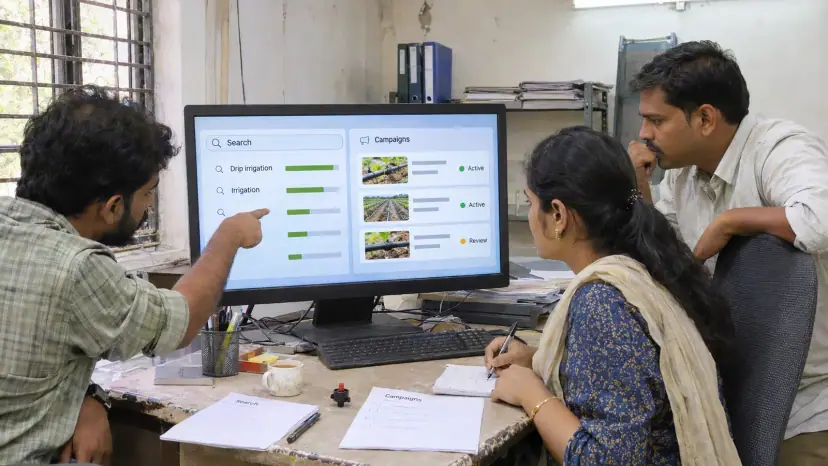
Our check of local and agricultural resources dates from 5 October 2026, so look at current instructions again before changing a campaign. Photographs illustrate the topic only and are not verified pictures of local offices, customers or farms.