Chennai Agriculture Marketing: Getting an Export Buyer Brief Ready
A product name will not carry a sale for an agricultural supplier selling through Chennai. Whoever is weighing up a consignment wants specifications, packing details, signs of capacity and a responsible person to question. So this guide is for agricultural and processed-food businesses preparing for buyer enquiries, not a page of farming advice. We can help organise your approved product information, build landing pages and route enquiries, all remotely from our Noida office.
Check These Official Chennai Resources Before Advertising
You will find the Chennai regional office of APEDA, at Shastri Bhawan in Nungambakkam, in its official contact directory. Use the current directory to reach the right office about your product. Older materials may give a different location, so confirm the address before visiting. A listing does not show that a product, exporter or campaign has been approved.
There is also a Chennai entry on the APEDA regional export-facilitation meeting page. Read the current instructions there before you take part, and go in with questions about your product category, your intended destination and what you still need to verify. Both links are independent resources. We claim no APEDA affiliation, and we cannot obtain registration, clearance or export orders for you.
Plan Each Page Around One Product and One Buying Decision
Keep bulk agricultural supply and packaged consumer food apart. An importer comparing a bulk ingredient may want to talk about grade, packing and sampling, while a distributor looking at a packaged line may want a catalogue and a commercial discussion. Give each the product page that suits them. A Chennai contact address does not mean the goods were grown or made in the city, so name the real origin and processing location wherever you have them documented.
- Product specification: set out the variety or formulation, the grade, the pack format and the specification sheet on offer, then ask your responsible technical person to sign off the wording.
- Availability: tell buyers how to confirm today's supply and dispatch arrangements, and leave out year-round promises or shipment dates until operations has confirmed them.
- Evidence: show approved photographs, say what any test report covers and when it was done, and use a certification mark only where it is authorised and applies.
- Buyer fit: find out the product, destination, intended use and order requirement, and whether the buyer wants a sample or a commercial quotation.
If your trading or processing team is based in Chennai, the brief gives marketing and operations a clean handoff. Your website should cover what a buyer can assess online and show which details need fresh confirmation. Do not paste the same catalogue across lots of city pages, and do not pass off a stock photograph as your own processing facility.
Keep AI on Approved Information and Hand Off to People
Product questions, catalogue drafts and summaries of incoming enquiries are all reasonable jobs for AI. Feed it a reviewed source pack, though, and never ask it to work out shelf life, export eligibility or how a product performs. Where you provide information in Tamil and English, someone competent in both should check the technical terms and enquiry instructions before anything is published.
Your enquiry form can stay short: the product, the buying organisation, the destination, the quantity wanted and how they prefer to be contacted. Say why you ask, and limit access to the team that needs the details. Questions on certificates, destination requirements, payment or shipment commitments should go to an authorised person. Marketing support never replaces product testing, export paperwork or professional advice.
Name who answers what. The technical person owns specifications and test reports. Operations owns stock, packing and dispatch dates. Sales owns the quotation and the buyer relationship. A buyer who has to chase three people for one answer will go elsewhere, so the assistant should tell them which person is dealing with the question and when to expect a reply. If a reply is late because someone is travelling, record that, and name a backup for each role.
One sample request, followed to a quotation
This is a planning example, not a real buyer. An importer's purchasing team writes to ask for a sample of a spice lot, and wants to know the packing and the earliest dispatch. The sales contact is not sure whether they want a trial sample or a commercial lot.
The assistant asks the four questions the brief needs: which product and grade, which destination, what the intended use is, and whether this is a sample or a quotation request. It then looks up the approved specification sheet for that grade and shows which version it is using. Dispatch timing is not in the pack, so it says that operations will confirm.
Operations checks what is in stock and when it can be packed. The technical person checks that the specification sheet is current. Only then does sales reply, stating what the sample covers and what it does not. If the buyer then asks for a commercial quote, the sample result becomes one of the facts on the file, along with the destination's own requirements, which the exporter must check independently.
Checks to complete before the page goes live
- Specification sign-off: The technical person approves each specification line, and the date goes beside it.
- Test reports: A report is shown only with its scope and date. If it covers one lot, the page does not imply that it covers all lots.
- Packaged food: If a line is sold as packaged food in India, FSSAI labelling and licence rules apply. Ask whoever holds the licence which details must appear and where.
- Destination requirements: Treat them as the buyer's and exporter's to confirm for each shipment. The page should not suggest that any product is accepted anywhere.
- Enquiry data: Contacts collected through the form are used for that enquiry, shared with the team that needs them and kept as long as the company has decided, with the DPDP Act 2023 in mind.
Any line that fails stays off the page, so that no one has to take it down after a buyer has acted on it.
Judge Results by Enquiry Quality, Samples and Follow-Up
An enquiry counts as qualified when it matches a product you have and a market you can really serve. Keep count of sample requests, suitable requests for quotation and agreed next steps. Note missing specifications and unsuitable destinations too, as they show which recurring questions the page should answer better. A click or a form submission is not evidence of an export order.
Bring your approved catalogue, product evidence, target buyer markets and existing sample-to-quotation process to a consultation. We can then talk through agriculture technology solutions, search campaigns and CRM enquiry workflows. Request a free consultation and we will define the scope together. We claim no Chennai branch and guarantee no commercial outcome.
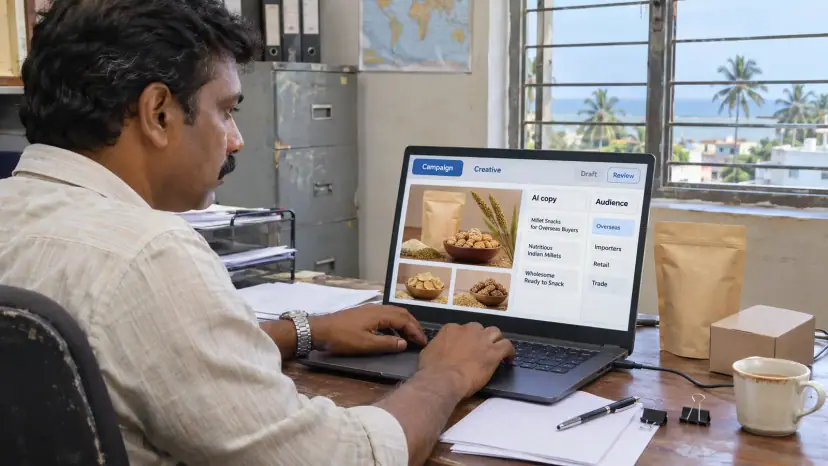
We checked the official resources on 2 October 2026. Confirm provider instructions and product information before using them in a campaign, and review the resource links every quarter. Treat the hero picture as an illustration of the topic.
Decide in advance what result would change the plan. If most sample requests end without a quotation request, look at the sample itself, its packing or its specification before you look at the advertising. If many enquiries come from destinations you cannot serve, rewrite the opening of the page so that those buyers can tell at a glance.