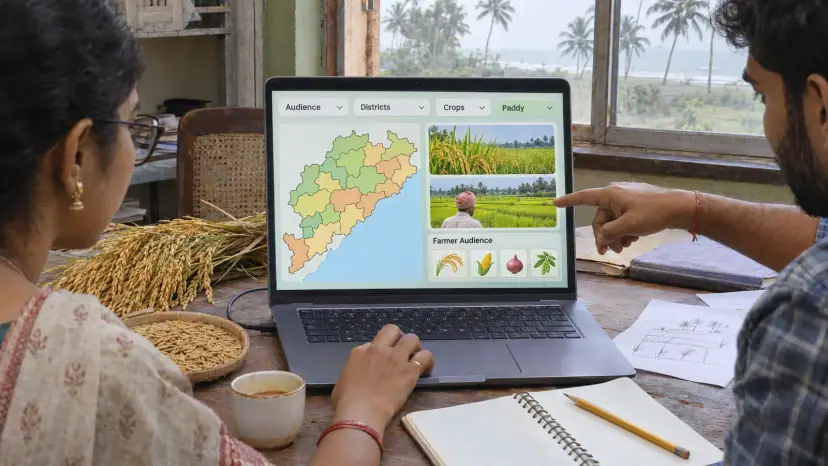
Bhubaneswar farm and agritech enquiries: answering by lot, with the market source shown
Before anyone answers a buyer about a lot, someone has to know which lot it is and where the market figure came from. This guide helps Agriculture and AgriTech teams serving Bhubaneswar handle those enquiries: the details to collect, the local source to consult, the jobs an assistant may do and the points where a person must approve the next step. Treat every workflow here as a planning example; none is a reported result for a Brainguru client. Any service gets scoped to your real business, data and permissions.
Khordha, Bhubaneswar and what a state-capital audience does not tell you
The official profile of Bhubaneswar Municipal Corporation places the city in Khordha district. Hold your city operating address apart from the wider district. Selling to an audience in the state capital also says nothing about coverage across Odisha.
Your first stop is Bhubaneswar Municipal Corporation. It gives you local administrative context and nothing more: it cannot show market demand, commercial availability or any endorsement of a private business. Note the Bhubaneswar site on one line and the wider Khordha district on another, then check that location against your approved business record. Where the two differ, a reviewer settles it before the page or assistant offers directions, coverage details or an appointment instruction.
The enquiry brief for a Khordha or Bhubaneswar lot
Work from the fields below as your brief, in place of a city name set beside an unrelated national offer. Each statement stays tied to its source and its reviewer. When something is missing, log the gap and pass it to a person; the model must not guess.
- Actual farm, seller or collection location: Note the Bhubaneswar site and the wider Khordha district separately. The real operating address counts here, not the advertising audience.
- Commodity, grade and lot identity: Name all three, so an answer about one lot is never read as true of another.
- Quantity and availability source: Record how much is on offer and which record shows it. Without that record, the quantity stays an open question for review.
- Dated market-information reference: Keep the reference with its date and current version. A photograph or a city name proves nothing about the market.
- Buyer delivery/export question: Write down whether the buyer wants delivery or export and what they need next, and set aside unsupported or misrouted requests.
- Seller/technical reviewer: Name the seller or technical person who can confirm the answer before the buyer hears a next step.
Picture a sample Bhubaneswar request. Until the location and the commodity, grade and lot details are both confirmed, nobody suggests a commercial or professional next step. Whatever stays unconfirmed travels with the handoff, marked open, so the receiving team gets a real question, not a lead dressed up as qualified.
An example for planning: a processor writes asking about a lot and wants to visit the storage point before agreeing a purchase. The assistant checks the lot record for the collection location, which may differ from the office address, and tells the buyer which location is on record. It passes the visit request to the seller's contact as a request, with the lot reference. The seller decides whether a visit is possible and when, and nothing is arranged before that.
Where the assistant helps and where Odisha sellers still decide
Every agricultural enquiry turns on specifics: commodity, lot, grade, quantity and the collection or delivery location. AI can sort buyer questions and pull approved product information, yet a market figure with an old date never becomes the seller's quote for today. Input-sales questions, produce procurement, agritech demonstrations and export enquiries also need splitting up, since each calls for its own reviewer and evidence.
Link only the sources and systems the business has authorised: an approved knowledge pack, the relevant operational system and, if needed, a CRM or intake route. Each answer should carry a note of the source version it drew on. Before using live customer data, test the access permissions and who can change the content. Drafts, predictions and extracted fields all serve the reviewer, and none of them commits the business commercially.
Decide who owns each part of the lot record. Whoever handles the storage point knows the real quantity, the quality lead knows the grade, and the sales head sets the price. When one spreadsheet is updated by all three at different times, the assistant ends up quoting from a mix of dates. Agree which source is current and mark the date on every field.
Yield, pest and export claims to keep off the page
Never promise yields, pest-control results, export acceptance or a subsidy. Any crop advice or product-use claim has to rest on a suitably qualified source. APEDA's resources cover the agricultural and export functions it supports, so do not present them as blanket approval for seafood or for every commodity. Keep real lot evidence and the seller's current terms visible.
APEDA official resources give you an independent sector reference. Recheck current instructions and ask the responsible professional whether they apply to your plans.
Odia and English, local search and what to measure
Where your audience needs Odia and English, competent speakers should review the terminology, the locality names and the proposed next step. Weigh these options up with the business; they do not mean every customer uses them or that Brainguru supplies every translation. Keep the real address and one contact route consistent across the page and your business records, and do not set up extra offices or profiles to fake a local presence.
The person asking may be in Bhubaneswar while the order is fulfilled elsewhere, so log both locations separately. Page content and enquiry routing should use the approved serviceable area. Five stages get separate counts: commodity enquiry → lot/grade review → quantity/location confirmed → quote → fulfilment. A click or a conversation is not revenue, so rejected, cancelled and unsupported requests also count when you evaluate.
Four tests matter here: an unconfirmed grade, a stale price reference, a seafood export enquiry and a product-use question that needs an expert. Hold the reviewed outcomes against the business's own baseline before you raise spend. Read the search queries for mismatched intent, then fix the answer or handoff concerned. We cannot guarantee rankings, a place in AI answers, lead numbers or a return on investment.
Early on, compare the questions buyers ask before visiting with the questions they ask after. A pattern of post-visit complaints about quality suggests that the descriptions on the page claimed more than the lot delivered, and the wording, not the traffic, should be corrected.
Further reading and your Bhubaneswar consultation
Agriculture & AgriTech solutions sets out the industry scope, and Demand Forecasting for Indian Distributors: Data Requirements and Pilot Evaluation goes into implementation detail. That article covers a related workflow and is not evidence of client work in Bhubaneswar.
Other planning tasks in Bhubaneswar sit under Logistics & Supply Chain and E-Commerce. The Bhubaneswar and other city guides page lets you compare supported information and official references.
A free consultation works best with these in hand: the actual farm, seller or collection location, the commodity, grade and lot identity, your approved source material and the reviewer who can decide the next step. The work is delivered from our Noida office; no branch in Bhubaneswar or elsewhere in Odisha is claimed. Scope, integrations and on-site work are settled one case at a time.
We checked the local and sector resources on 5 October 2026; look again at current instructions before changing a campaign. Photographs only illustrate the topic; none is a verified picture of a local office, customer or facility.