In this article
- India's QR Moment
- QR Marketing Use Cases Indian Businesses Underuse
- The "QR + UTM" Combo Most Marketers Miss
- Designing a QR Code That Actually Gets Scanned
- Static vs Dynamic QR Codes
- Use the Free Brainguru QR Generator
- Measuring QR Campaigns in GA4
- Sector-Specific QR Playbooks
- UPI QR vs Marketing QR: You Need Both
- An Illustrative Scenario: Salon Review Collection
- Frequently Asked Questions
- The Bottom Line
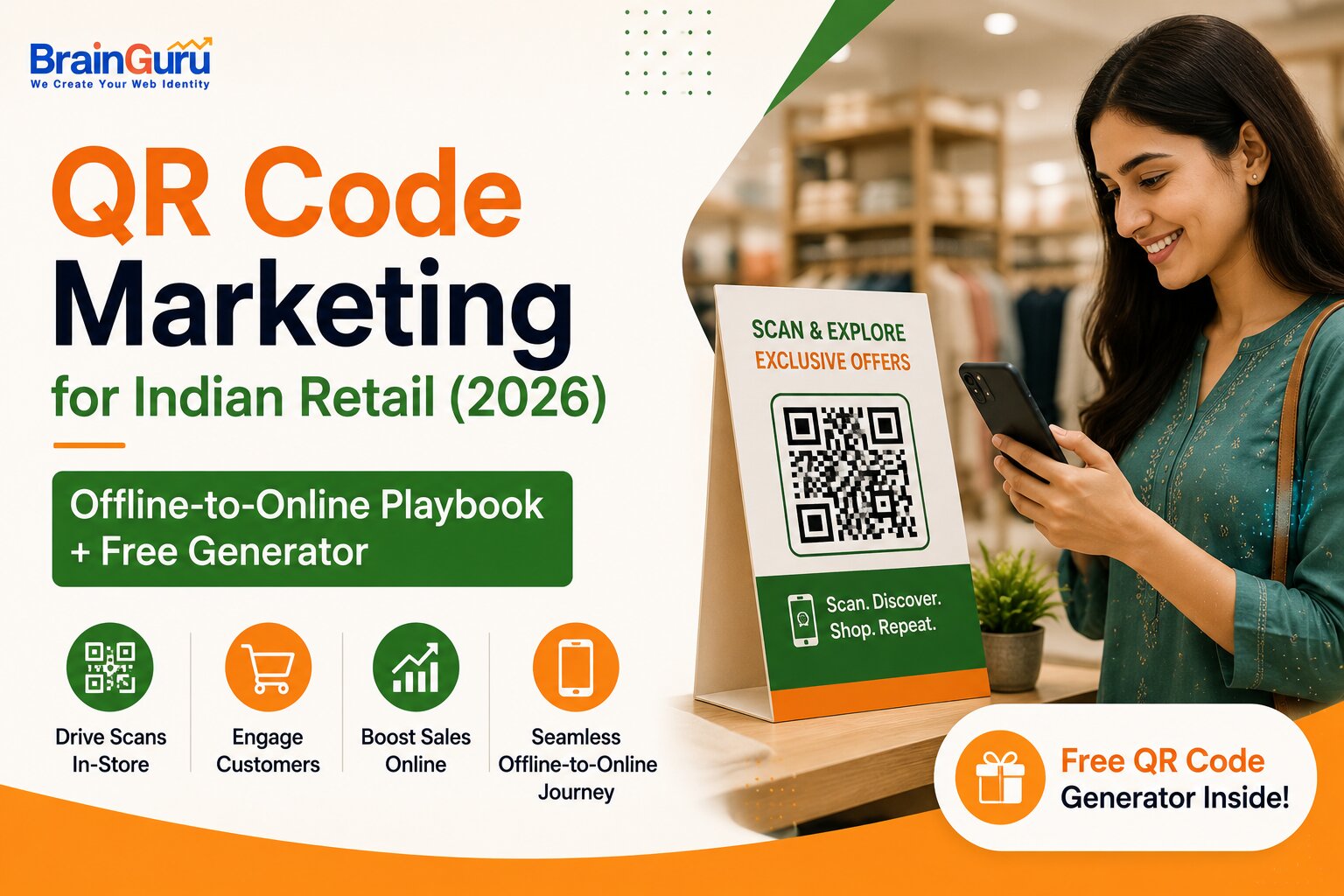
If you've watched an Indian customer pay a vegetable vendor by scanning a QR code on a piece of paper, you've witnessed one of the most efficient consumer behavior shifts in modern Indian commerce. UPI made QR scanning universal: fast, casual, frictionless. Yet many Indian marketers, who should be the first to exploit this behavior shift, are largely still using QR codes as static, untrackable links. The opportunity is large: QR code marketing in India is one of the cheapest, most accessible bridges between offline and online available right now.
This is a 2026 playbook for QR code marketing for Indian retail, services, and D2C brands. It covers the use cases that tend to work, the QR-plus-UTM combination most marketers miss, how to design QR codes that actually get scanned, and how to measure the results honestly.
India's QR Moment
India has one of the world's most QR-fluent consumer populations. UPI now processes billions of transactions every month, and scanning a QR code to pay has become an everyday habit. Indian consumers across socioeconomic strata, from metro cities to smaller towns and villages, scan QR codes routinely.
For marketers, this means: the friction of "the user has to scan a QR" is unusually low in India. The same friction that might hold back a campaign elsewhere tends to be far less of a barrier in the Indian market.
Yet most Indian businesses use QR codes only for payments. The marketing applications (review collection, WhatsApp opt-in, content access, attribution) remain underused. The brands that build these habits early can capture meaningful value.
QR Marketing Use Cases Indian Businesses Underuse
1. Restaurant Menu (With WhatsApp Opt-In)
The basic implementation: a printed menu accessible via QR. The advanced implementation: the menu QR also collects an optional WhatsApp opt-in for the brand's marketing list. Each diner can become a future marketing touchpoint, at low acquisition cost.
2. Salon / Spa Review Collection
A post-service QR at the billing counter that opens WhatsApp and sends an auto-reply asking for a Google review. The combination of timing (immediately after service), familiarity (WhatsApp), and one-click linking (a direct Google Business Profile review URL) can lift review-collection response meaningfully compared with email follow-ups.
3. Real-Estate Site Signs (Lead Capture)
A sector hoarding for a new project can include a QR code that opens WhatsApp Business with an auto-message such as: "Hi, send me details for [Project Name]". An auto-reply can then send the brochure and schedule, and ask for a site-visit slot, a smoother path than asking passers-by to note down and dial a phone number.
4. In-Store QR for Product Info / Reviews / WhatsApp Catalog
For D2C retail in offline stores: a QR on the shelf can open a product information page or a WhatsApp Business catalog, bridging in-store browsing with online research.
5. Event / Popup → Attribution
At events, popup stalls, or experiential activations: a QR code can drive users to a UTM-tagged landing page so you can measure the response from that activation. Much event marketing in India goes unmeasured. QR + UTM helps fix that.
6. Print Ads → Digital Landing
Print ads in magazines, newspapers, hoardings, and packaging can all become digital touchpoints via QR. With proper UTM tracking, you can begin to measure print marketing response rather than guessing at it.
The "QR + UTM" Combo Most Marketers Miss
One of the highest-leverage QR patterns is combining QR codes with UTM-tagged landing pages. Without UTM tagging, a QR campaign is largely a black box. With it, you can see which physical location, billboard, or event drove which session and conversion.
The pattern: every QR code points to a URL with embedded UTMs:
https://yoursite.com/landing?utm_source=qr_offline&utm_medium=qr&utm_campaign=2026_diwali&utm_content=mall_inorbit_l3
Designing a QR Code That Actually Gets Scanned
Many QR codes get poor scan results not because users won't scan, but because the QR is poorly designed. Some practical design rules:
- Size matters: a common guideline is roughly 2.5cm × 2.5cm for arm's-length scanning (menu, brochure), larger for shelf or billboard placement, and substantially larger for outdoor hoardings meant to be scanned from several meters away. Scale the size to the expected scanning distance.
- Contrast is essential: dark QR on a light background scans most reliably. Light QR on a dark background can fail.
- Frame the QR: a clear quiet-zone border around the QR (a few millimeters) improves scan reliability.
- Add a clear CTA: "Scan to get menu", "Scan for an offer", "Scan to leave a review". Tell users why to bother.
- Test before printing: scan with a range of devices (common iPhone and Android models, including a mid-range handset) before committing to a print run. Print quality affects scannability.
- Avoid extreme customization: heavily branded QR codes with large logos in the middle can look nice but may reduce scan reliability. Favor high-contrast designs.
Static vs Dynamic QR Codes
Two types exist:
Static QR codes: the URL is baked into the QR and cannot be changed. Free to generate. Best for: payment QRs, low-cost campaigns, one-off events.
Dynamic QR codes: the QR points to a redirect URL that you can update. The QR stays the same; the destination can change. Best for: print campaigns that may run for months, packaging that ships ahead of campaigns, and evergreen materials.
For campaigns that may evolve over time, dynamic QRs are usually worth the small investment. Many QR generators offer both.
Use the Free Brainguru QR Generator
Build your tagged URL first (keep UTM values to one agreed naming convention), then turn it into a QR code with our free QR code generator. It makes static codes; for codes you can re-point later, use a dynamic-QR or redirect service you control. Output is high-resolution PNG / SVG, ready for print or digital use.
Where a campaign may change, consider generating dynamic QR codes, so you don't have to reprint brochures or banners.
Measuring QR Campaigns in GA4
Once QR codes carry UTM parameters, GA4 can capture the traffic. Some configuration tips:
- Create a custom channel grouping in GA4 → Admin → Data display → Channel groups. Define a "QR Offline" channel that captures utm_source=qr_offline.
- Build a Looker Studio dashboard filtered to the QR Offline channel, to see sessions and conversions per location/asset.
- Tag conversion events: ensure your conversions (form submits, purchases) are tagged so they roll up against QR campaigns.
- Account for delayed conversion: many QR scans don't convert immediately. Look at trailing windows, not only same-day numbers.
Sector-Specific QR Playbooks
D2C Brand (Packaging QRs)
Every product package can include a QR that opens WhatsApp Business with an auto-message asking for product feedback and an optional opt-in to subscription/reorder marketing. The cost of acquiring a marketable contact this way can be very low.
Real Estate Developer
Site hoardings, brochures, and contact cards can all include a QR code with an embedded UTM identifying the source. Site-visit attribution becomes data rather than guesswork.
Restaurant Chain (Menu + Ordering)
A table QR can open the menu plus a WhatsApp ordering flow. The marketing list builds itself over time, and loyalty programs can hook in.
Healthcare Clinic (Appointment Booking)
A reception QR can open a WhatsApp consultation booking flow with DPDP-aligned consent (see the linked DPDP guidance below).
Education / Coaching
A QR at the institute can open a free demo-class booking flow, often a smoother path than a traditional phone-number CTA.
UPI QR vs Marketing QR: You Need Both
A common confusion: UPI QRs (for payments) and marketing QRs serve different purposes and should not be conflated.
| Aspect | UPI QR | Marketing QR |
|---|---|---|
| Purpose | Payment | Marketing acquisition / engagement |
| Destination | UPI app + amount | Web URL / WhatsApp / app deep link |
| Tracking | Payment transaction | UTM-based attribution |
| Use case | Receive payment | List building, attribution, content access |
Display both at appropriate touchpoints, for example, a UPI QR at the billing counter and a marketing QR at the menu or product display.
An Illustrative Scenario: Salon Review Collection
To make the review-collection use case concrete, here is a hypothetical, illustrative example, not a real client engagement, and with no claimed outcomes. Imagine a small salon chain that wants more Google reviews without spending on email and phone follow-ups. A possible setup:
- A table tent at each station: a QR plus "Loved your service? Tell Google in 30 seconds → Scan".
- The QR opens a WhatsApp Business chat with an auto-reply such as: "Thanks for visiting! Would you mind leaving a quick review? Direct link: [Google Business Profile review URL]".
- An optional WhatsApp opt-in collected for future marketing, with appropriate consent.
- Dynamic, UTM-tagged QR codes per location, so any response can be attributed.
Whether this lowers review-acquisition cost or improves local visibility will depend on your service quality, location, staff prompting, and follow-through. Treat it as a design pattern to test and measure, not a guaranteed result.
Frequently Asked Questions
Do Indian users actually scan QR codes?
Comfort with QR scanning in India is among the highest in the world, driven largely by everyday UPI payments. Familiarity is strong in metros and continues to grow in tier-2 and tier-3 markets, though scanning still depends on having a capable smartphone and connectivity. Test with your own audience rather than assuming a fixed scan rate.
What format should my QR codes be: PNG, SVG, or PDF?
For print: SVG (vector, scales without quality loss). For digital: PNG at high resolution. PDF when embedding in documents.
Are there QR code rules in DPDP?
DPDP doesn't regulate QR codes themselves. But the landing page should give clear notice and collect valid consent before using personal data for marketing: the DPDP Act's notice and consent duties apply from 13 May 2027, and the IT Act's 2011 SPDI Rules apply until then. See DPDP Compliance for Digital Marketers.
Can I include branding inside a QR code?
Yes, but minimally. A modest logo in the center can usually be added without breaking scan reliability, thanks to error correction. Beyond a small area, scan errors compound, so test before printing.
Should QR codes work without internet?
The scan itself (decoding the URL) works offline, but most landing destinations require connectivity. Plan for the fact that the user needs internet to reach your page.
How long do dynamic QR codes stay valid?
For as long as your QR generator service remains active. With some free services, validity may expire. For long-term campaigns, use a service you expect to keep running, or a self-hosted redirect you control.
The Bottom Line
QR code marketing in India in 2026 is a strong offline-to-online bridge. Indian consumers scan QRs with little friction, because UPI made it muscle memory. Yet most Indian brands still use QRs only for payment, missing the marketing leverage.
The use cases here (menu, review collection, real-estate signs, in-store product info, event attribution, print-to-digital) are each relatively quick to implement. The QR + UTM combo finally lets you attribute offline marketing. The cost of implementation can be low; the cost of inaction is continuing to leave offline-to-online value on the table.
For implementation assistance or QR-centered campaign design, see our digital marketing services. Generate codes free with our QR code generator. For UTM-tagged URL building, see our UTM link builder. Or reach out via our contact page or call +91-8010010000.
Related Articles
Twitter (X) Marketing for Business: A Practical Guide
Twitter marketing (now X) still rewards concise, high-impact posts. Learn how to build a strategy, pick formats, and turn followers into website leads.
Read More
Facebook Marketing for Business: A Practical Guide
Facebook marketing turns a social page into a growth channel. Learn how Pages, Messenger, video, ads and analytics drive leads and sales for Indian businesses.
Read More
Facebook Ad Targeting: How It Works for Businesses
Facebook ad targeting explained: the signals behind it, how it changed since 2014, and how businesses can use it ethically to reach the right audience.
Read More
Comments
Be the first to share your thoughts on this article.